Regenerative grazing and livestock management courses are presented under many different names. Each has its own emphasis but they all share a common objective: to improve the ecological and financial performance of the farming business. While the terminology may differ, the underlying management principles are similar.
To understand the principles it may help to view an extensive (veld-based) livestock enterprise as a simple value chain. Every kilogram of beef, lamb or wool begins as an energy input from the sun and ends with food on someone’s plate or a garment that they wear. It is a value creation system. Every link in the chain has the potential to either help or to hinder. Management of the chain either converts available resources into greater value, OR it limits the value created by the entire system.
The “bare bones” chain can be represented thus:
Sun → Plants → Animals → Products → People
Although each of these links is complex and contains interacting components, the overall process is surprisingly simple. Sunlight is captured by plants, plants convert solar energy, water and soil nutrients—in collaboration with soil microbes—into forage for livestock. Livestock and microbes convert forage into meat and other products. The farm converts livestock into products that are sold, ultimately those products create value for people.
The value chain is powered by sunlight and rainfall, which drive one biological production cycle each year. It is a cyclical biological system driven by external energy inputs. At the completion of each production cycle, management has the opportunity to evaluate the results and assess performance, adapt management practices and set new goals for the next cycle.
- Nature provides the next production cycle.
- Management determines whether the next cycle is better than the last.
Every year nature gives the farmer another opportunity, but it is management that determines whether that opportunity is converted into greater ecological function, higher productivity, improved cashflow and improved profitability.
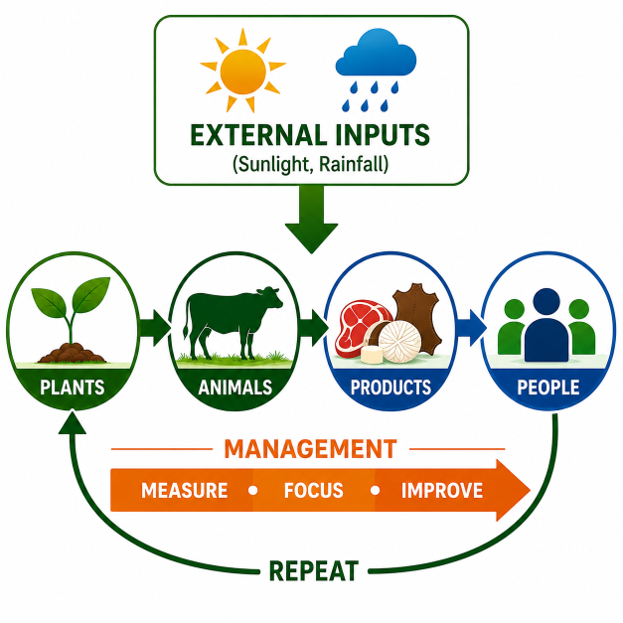
You cannot control the amount of sunlight or rainfall, but you can control how effectively those resources are converted into forage, livestock production and profit. Improve the biological effectiveness of the system, while you focus your management attention for optimum effectiveness, represented thus:
External Inputs (Sunlight, Rainfall)
↓
Plants → Animals → Products → People
↑
Management (Measure • Focus • Improve. Repeat)
Your management is not just another link—it is the coordinating function that observes the system, allocates attention and begins the next production cycle with improved decisions. A value chain becomes a continuous improvement cycle. Your greatest leverage lies not in controlling the weather or the market, but in improving the effectiveness of your own management.
Like every chain, the performance of the whole system is determined by its weakest link. This may sound like a cliché, but it remains one of the most important principles in farm management. Exceptional performance in one part of the system cannot compensate for poor performance in another. Improving a strong link while neglecting a weak one does little to increase the performance of the business as a whole.
This is precisely what Herdscape Regenerative Grazing and Livestock Management seeks to address. The purpose is not simply to increase production, but to identify the factors limiting the performance of the entire system and to improve them in the correct order.
Management principles help us answer three practical questions:
- Which parts of the system are under our control?
- Which factors are beyond our control?
- Where should management effort produce the greatest improvement?
Understanding the answers to these questions is the beginning of effective management.
Farmers who want to apply these principles to their own land and livestock can explore
Herdscape’s online regenerative grazing and livestock management course.
Sun
The production cycle begins with inputs of sunlight and rainfall. Together they provide the energy and water that drive every biological process on the farm.
They are external factors. No manager can create more sunshine or guarantee more rain. However, management profoundly influences how effectively rainfall is captured, stored in the soil and converted into plant growth. Although rainfall itself cannot be controlled, the effectiveness of the rainfall you receive can be optimised.
The paramount principle—the cornerstone of all sound grazing management—is that stocking rate (number of animal units on the farm) must be balanced with carrying capacity (the veld’s ability to supply forage without degrading). Overstocking or overgrazing is not just counterproductive — it is self‑defeating. Ultimately it depletes the very resource base that sustains the herd. The aim is dynamic balance not a fixed number, because carrying capacity fluctuates with rainfall, season and veld condition
Plan how to stock your farm, monitor how much veld forage is produced and how much is harvested by your livestock. The means by which you keep your records and analyse them must be simple and effective otherwise it is unlikely to be done. Complexity kills continuity.
Plants (The Veld)
The “Plants” link in the chain includes the soil, soil microbes, plants and biodiversity that make up the grazing ecosystem, together with all the biological processes that determine veld productivity.
This is where solar energy becomes forage.
Management decisions affecting carrying capacity, grazing pressure, recovery periods, species composition, soil cover, soil biology and water infiltration all determine how effectively the veld converts sunlight and rainfall into usable feed.
Unlike rainfall, these are largely internal factors and therefore management responsibilities.
Principle: Timing of grazing, time of grazing, and time for rest and recovery must be controlled. These three dimensions form the primary principle of veld management, they are interdependent:
- Timing sets the season and growth stage.
- Time of grazing determines severity.
- Time for recovery ensures regeneration.
When they are planned, monitored and controlled, soil life, plant vigour, biodiversity and animal performance align naturally. You manage not only for veld and animal productivity but also for regeneration of soil health and for an increase in biodiversity.
Animals
The “Animals” link in the chain includes everything influencing the efficiency with which livestock convert grazing into saleable production.
Nutrition, stocking rate, grazing management, animal health, reproduction, genetics, handling practices and mortality all influence animal performance.
Most of these are under management control, although disease outbreaks, droughts and some market-related factors may not be.
Here is a more developed version that places stockmanship in the broader context of regenerative grazing and livestock management:
Principle: Practise a high standard of stockmanship. Stockmanship is the knowledgeable, observant and skilful management of livestock. It combines an understanding of animal behaviour, nutrition, health and welfare with the ability to make timely management decisions that improve both animal performance and the long-term productivity of the farm.
Good stockmanship extends beyond caring for animals. Decisions such as the timing and length of the breeding season, stocking density during grazing periods, herd composition, the provision and placement of water, strategic supplementation, animal health interventions and the prioritisation of livestock with the highest nutritional demand all influence the biological and financial performance of the business.
Livestock should not be viewed merely as consumers of forage. They are active participants in the functioning of the ecosystem, livestock are a management tool for influencing ecosystem processes.
Products
The “Products” link represents the point where biological production becomes economic value.
For an extensive livestock producer this includes breeding stock, weaners, slaughter animals, wool, hides or any other products sold from the farm. It also includes animals sold to other producers, directly to consumers or into the downstream value chain where further value is added through feeding, processing, packaging and retailing.
While producers influence product quality, timing of sales and production costs, they generally have limited influence over market prices. They are price takers rather than price makers.
Consequently, increasing profitability depends at least as much on producing efficiently as on obtaining favourable prices.
People
The final link is people. This includes the farm owner, family members, managers, employees, advisers and everyone whose decisions influence the business. It also includes buyers, processors, retailers and ultimately consumers. It includes distribution of financial resources.
The producer has direct influence over the people within the business but progressively less influence over participants further along the value chain.
Although you cannot control what happens after livestock leave the farm, consumers increasingly expect food to be produced responsibly. As a result, producers remain accountable for environmental stewardship, animal welfare and product integrity throughout the production process.
Where Management Matters Most
The purpose of regenerative grazing and livestock management is not to optimise every part of the chain simultaneously. That would be impossible.
Instead, successful management seeks to identify the weakest link at any point in time and improve it before moving attention elsewhere. It recognises that the overall performance of the system is determined by the link that is weakest right now. Improving anything other than that bottleneck may produce activity, it may be entertaining but it seldom produces significant progress.
The manager’s task is therefore not to improve everything. It is to identify what is currently limiting the performance of the whole system and focus your management attention there.
As the owner of your farming enterprise you have a unique responsibility. It is your responsibility to work ON your own business. No-one else carries that responsibility. There is no hand-out if your farm business fails. Your management is the centre of your farm business, it must remain there regardless of what else might change.
If you are ready to move from understanding to application,
explore the Herdscape online course in regenerative grazing and livestock management
Read more about Veld and Grazing Management Options:
- From Set Stocking to Regenerative Grazing: Management Changes the Equation
- Farm Records: Five Numbers That Matter
- Profitable Farming Is A Moving Target. Only A Few Will See When It Moves.
- The Discipline of Regenerative Grazing and Livestock Management: Precision in Execution
- Set-Stocking vs Rotational Grazing: An Honest Comparison





 English
 Afrikaans