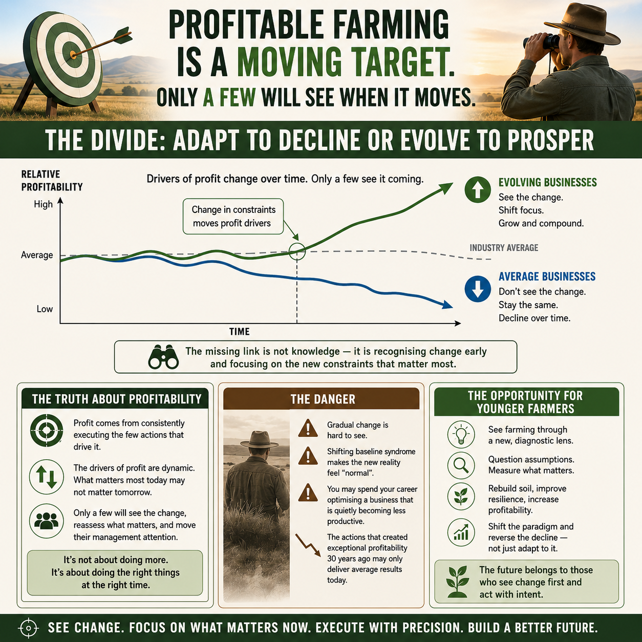
Profitability in farming is achieved by consistently executing the few management actions that actually drive profit. Everything else, however interesting, is just a distraction.
The missing link is not knowledge—it is recognising that the drivers of profit are dynamic; they change. The most profitable businesses evolve with the shift but most people fail to notice when it happened.
If the constraints that most limit profitability change then the relative importance of your different management actions will also change. Only a few will respond quickly to adapting their management attention to where it should now be concentrated.
Every Generation Inherits a Different Business
One of the greatest obstacles to recognising change is the phenomenon known as shifting baseline syndrome. Each generation unconsciously accepts the farming conditions it first encounters as if it was “normal.” Farmers tend to compare today’s conditions, not with what was possible a century ago, but with what existed when they first started farming. The actions that created exceptional profitability thirty years ago may only maintain average performance today. You do not need just to execute well—you must regularly reassess the priorities to be executed and establish where your management attention should be focussed.
As each generation replaces the previous one, gradual changes become invisible; because each change occurs slowly the new generation may simply accept the new reality as normal. Few will recognise that the baseline itself has shifted. Each generation inherits land and livestock, but it also inherits the accumulated consequences of previous management decisions. Sometimes they inherit healthier soils, better genetics and stronger businesses. Sometimes they inherit depleted landscapes, higher costs and lower resilience.
This realisation represents a wonderful opportunity for younger farmers to see farming through a new, diagnostic lens; to shift the paradigm and reverse the decline in profitability rather than just adapt to it. If these gradual changes go unrecognised, you may spend your career trying to optimise a business that is already become less productive.
Farmers who want to apply these principles to their own land and livestock can explore
Herdscape’s online regenerative grazing and livestock management course.
Measuring Against the Wrong Benchmark
The danger of these shifting baselines is that you may begin to benchmark yourself against your neighbours and peers instead of against the real productive potential of your land and the real profitability potential of your business. If everyone is experiencing rising input costs, narrowing margins and market volatility and risk, those trends begin to feel inevitable. Do not just accept this as the “cost of farming”, rather recognise it as a management challenge that can be addressed.
Information Breaks the Illusion
Reliable information is the antidote to shifting baselines. Accurate records reveal whether profitability is improving or declining. Production records expose changes in reproductive performance, carrying capacity and veld and animal production. Your records are the bridge between operating actions and financial reality — especially when evaluating investments like improved genetics or purchased stockfeed. If a bull costs R50,000 and his calves average 20 kg heavier at weaning, records will show whether that extra weight across the herd pays back the investment in 2 years or 10.
Purchased feed is often the biggest direct cost. Records reveal whether it is a cost sink or a profit lever. If R100,000 of feed raises conception from 70% to 90%, your records show whether the extra calves weaned cover the feed bill and add margin. Without records and comparison of performance from year-to-year your decisions about genetics or feed may not be rational. Test the claims about what improved genetics and stockfeed will bring. If you are improving genetics, purchasing feed or increasing turnover but conceptions do not rise, gross margin stays flat or profitability does not increase then the baseline has shifted. Without records this cannot be discerned.
Ecological monitoring measures changes in ground cover, species composition, rainfall effectiveness and forage production. Without measurement, gradual decline is almost impossible to detect. With measurement, small changes become visible long before they become crises. Information alone does not improve profitability, its purpose is precisely to identify the constraint that most limits performance and to direct your management attention toward removing it.
The role of management is therefore not to optimise everything simultaneously, it is to identify the few management actions that matter most under current conditions and to execute them with precision and consistency.
The Centre and the Edge
Most beneficial change in agriculture does not begin in the centre of the industry. It begins at the edge. The centre represents accepted practice. It is where most producers operate, where conventional wisdom or “common knowledge” is formed and where success is measured against what everyone else is doing.
The edge is different.
It is occupied by the small number of producers who question accepted assumptions, measure outcomes rigorously and experiment with new ways of improving profitability. Time controlled grazing, precision agriculture, electronic identification, business accounting, genetic evaluation, satellite monitoring and regenerative grazing and livestock management all began at the edge, before becoming accepted practice.
The next important advance will almost certainly emerge from the edge rather than the centre. The challenge for you is to decide which new ideas represent genuine progress and which are merely passing indulgences.
The Competitive Advantage
In every generation there are only a handful of producers who recognise that the environment has changed and adjust their management accordingly. By the time the industry at large accepts the new reality, those producers have already established a lasting competitive advantage. They adapt while others are still defending yesterday’s assumptions.
But this advantage is not reserved for an elite minority. Access is open. The principles of adaptation, precision, and discipline are available to every producer who chooses to act. The difference lies not in opportunity but in recognition and execution.
Profitability is not simply a function of good execution. It is the product of executing the right actions for today’s reality—not yesterday’s—with discipline, precision and consistency. Information is the key to identifying new constraints before they become obvious, to detecting opportunities before they become mainstream.
Profitability is not achieved just by knowing how to do what was always done, but by executing with precision and consistency the few critical actions that actually drive profit. Everything else is a distraction.
The Principle of the Limiting Constraint
Every farm has problems, but only a few constraints truly limit profit at any point in time. You should not just work harder everywhere but identify the one or two constraints that are currently suppressing performance most severely. Whatever it turns out to be— stocking rate, reproduction, debt structure, marketing, water distribution, veld condition or cost control—the priority is not determined by habit or preference; it is determined by diagnosis.
Your management effort may often be allocated to the visible problems rather than these binding constraints. They are not always the same thing. A visible problem may irritate you but a binding constraint will limit the viability of your business. Managing for profitability requires the discipline to distinguish between symptoms and causes; concentrate your attention where the return on your management effort is greatest.
The Principle of Feedback
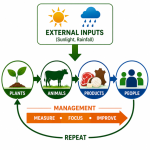
A farming business is a biological and economic feedback system. Grazing decisions affect plant recovery and forage supply. Those outcomes affect animal performance and cash flow. Cash flow affects your capacity to reduce risk and make better future decisions. The effectiveness of your management is not judged only by its immediate effect, but also by the feedback loop it creates. It should strengthen future options without weakening the system that must carry the business tomorrow.
Overgrazing may create temporary cash flow, but if it reduces plant vigour, ground cover and rainfall effectiveness, it converts today’s income into tomorrow’s constraint. The same principle applies to finance, labour, breeding, supplementation and infrastructure.
Ecological Capital Comes Before Annual Output
The productive capacity of your farm is created in the soil, the root systems, the water cycle, the breeding herd and the quality of your management decisions. Genetic potential is already very high. Profit is the harvest; ecological and managerial capital are the source. A business that increases output by consuming, or limiting, its underlying capital is not becoming more profitable in any meaningful long-term sense. It is liquidating its future.
The most dangerous business is one that appears profitable while quietly reducing its own productive potential. The most valuable management system is one that converts rainfall into forage, forage into animal performance and animal performance into profit while leaving the land more capable of repeating the process.
Stocking Rate Is a Profit Lever, Not a Tradition
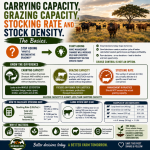
Few decisions influence grazing profitability as powerfully as stocking rate. It affects forage availability, animal performance, recovery periods, drought exposure, supplementary feeding costs, labour pressure and cash flow. Yet it is often treated as a tradition rather than a dynamic management lever. The question is not how many animals the farm has always carried, but how your management will affect the number of animals your farm CAN carry, profitably, per unit of rainfall.
The optimum stocking rate is seldom the maximum stocking rate. Maximum biological output can reduce profit if it increases costs, lowers individual animal performance, damages veld condition or removes flexibility in dry years. The profitable stocking rate is the one that balances total production, cost structure, ecological recovery and risk. It must be reviewed as rainfall patterns, forage composition, animal genetics, market prices and input costs change.
Keep Your Options Open
Resilient businesses preserve options. They maintain enough ground cover to capture rainfall, enough veld forage reserve to avoid panic decisions, enough financial margin to resist forced selling and enough management information to act early. They create cashflow when animals are sold, yes, but they make the profit when the animals are replaced, regardless of the volatility in the marketplace. They convert the buy-sell paradigm to a sell-buy paradigm. Keeping your options open has economic value because it allows you to choose rather than react.
Many poor decisions are not made because knowhow is lacking; they are made because previous decisions removed options. A farm with no forage reserve, no cash reserve and no timely information has fewer good choices. The principle is simple: management should not merely aim to maximise today’s output; it should protect the business’s ability to respond intelligently to tomorrow’s conditions.
Decision Discipline Matters More Than Complexity
The best management systems are not necessarily the most complicated but they do repeatedly generate effective decisions. A simple measurement, reviewed regularly and acted upon promptly, is more valuable than any sophisticated system that is ignored. The purpose of records, grazing plans, budgets and monitoring is not administration; it is better timing, better prioritisation and better execution.
Techniques will change. Technologies will change. Markets will change. But the principles remain: identify the constraint, protect the resource base, measure what matters, preserve your options, act early and execute the few critical actions with discipline.
There is a strategic framework that ties management actions directly to grazing principles, profitability drivers and the imperative of diagnosing the weakest link in the business model. This distinguishes the Herdscape philosophy from approaches that focus on individual techniques rather than management systems. It ties together accounting, grazing management, livestock management, goal setting and profitability into a single management framework.
Information on its own creates no profit. Plans create no profit. Grazing principles create no profit. Profit is created only when good information enables you to execute the right management actions at the right time, in the right place, with consistency.
If you are ready to move from understanding to application,
explore the Herdscape online course in regenerative grazing and livestock management
Read more about Veld and Grazing Management Options:



 English
 Afrikaans