Much of the confusion around regenerative grazing comes from complex terminology and the mistaken belief that it is a specific system or recipe. In reality, regenerative grazing is simply a practical way of managing animals, plants, soil, water and time so that animal production increases by enhancing the farm’s natural grazing resources.
The farm’s natural resources have little value on their own; animals convert them to something you can sell. The more your veld can produce and the better your animals perform on it, the stronger and more profitable your livestock business will be.
What Is Regenerative Grazing?
Regenerative grazing is not a grazing system. It is not a brand, a recipe, or a set of rigid rules.
At its heart, regenerative grazing is simply:
Managing livestock in a way that allows grass plants, soil life, and the ecosystem to recover, improve and become more productive over time.
The goal is not merely to maintain veld production. The goal is to regenerate it, leaving it healthier, more resilient to drought and more profitable than before.
To understand regenerative grazing, it helps to first understand some important terms.
Understanding the Language of Grazing
Carrying Capacity
Carrying capacity is the number of domestic animals and wildlife a farm can support over the long term without degrading the veld.
It is usually expressed as hectares per Livestock Unit (LSU) or the number of livestock units the farm can carry.
Carrying capacity is not fixed. As soil and veld condition improves, carrying capacity per unit of rainfall will increase. If soil and veld condition deteriorates, carrying capacity decreases.
A farm of 1,000 hectares may have a carrying capacity of:
- 1 LSU per 5 hectares under good veld conditions.
- 1 LSU per 12 hectares under poorer veld conditions.
The same farm carries more animals when the soil and veld are healthy. Carrying capacity can be calculated in dry matter terms (does not happen often) but there are guidelines available online, as well as local knowledge for those who are starting a veld-based livestock enterprise. Guidelines are based on average rainfall but please take note: CARRYING CAPACITY IS NOT FIXED.
The guidelines exist to assist you with your planning in the first year or two of farming. Thereafter you should update your farm’s carrying capacity based on actual rainfall and on actual stocking rates, both of which will improve with better management.
If you are already farming then you will have a good idea of how many LSU your farm can carry.
Grazing Capacity
Grazing capacity refers to the amount of forage available for domestic animals (livestock) at a specific time. It does not include the amount required by wildlife so grazing capacity is always less than carrying capacity.
Grazing capacity changes constantly according to:
- Rainfall
- Season
- Plant growth
- Veld condition
- Grazing and veld management
Good grazing management aims to match animal numbers to available forage as conditions change but also to improve the grazing capacity per unit of rainfall.
The best and probably the simplest way to calculate actual grazing capacity is to record actual rainfall, actual grazing days and the condition and amount of forage left in the camps after grazing. A grazing day is one LSU grazing for one day; a herd of 100 LSU grazing for one day is 100 grazing days or 100 “stock days” (SD).
The amount of dry matter a healthy animal rated at 1 LSU eats in a day is established at between 2% and 3% of its body mass. It is a simple matter to deduce that a herd or flock of healthy animals will eat what they need over a period of time, under your management. The number of grazing days taken means that that amount of grazing capacity was there to be taken. There is no need to calculate how much that is in dry matter terms.
Keep track of how many LSU are grazing, for how many days and make the link to what your veld produces per unit of actual rainfall by assessing how much forage is left.
Stocking Rate
Stocking rate is the number of animals actually placed on a given area (the farm or a particular camp) over a defined period.
For example:
- My farm is 3000 ha, I have 300 LSU on the farm on average throughout this year so my stocking rate is 1 LSU per 10 ha for the year.
- I have 150 LSU in that camp so my stocking rate in that camp at the moment is 150 LSU.
Stocking rate must always be aligned with grazing capacity. If my 3000-ha farm’s carrying capacity is 1 LSU to 12 ha the department or bank manager could say I can only carry 250 LSU per year, not 300 LSU, based on average rainfall. They could say that you are therefore overstocked by 50 LSU, but that would need to be validated by evidence of overstocking.
You cannot accurately judge an appropriate stocking rate from a distance by simply comparing actual animal numbers with a district guideline or benchmark. It must be assessed through farm records, direct observation and analysis of the available data.
If your records and your observations and evidence say you are not overstocked, even when you do receive close to average rainfall, then you must increase your carrying capacity benchmark. It is worth reiterating that carrying capacity is not fixed. There is no such thing as average rainfall on your farm, in any one year. In reality there is only actual rainfall.
If stocking rate (livestock plus wildlife) exceeds carrying capacity for too long without adequate rest:
- Plants weaken.
- Bare ground increases.
- Soil health declines.
- Productivity falls.
Stock Density
Stock density is often confused with stocking rate.
Stock density refers to how many animals are concentrated on a specific area at a specific moment, measured in livestock units (LSU) per ha.
One hundred cattle grazing a 100-hectare camp have a far lower stock density (1 LSU per ha) than the same cattle grazing a 5-hectare camp (20 LSU per ha).
High stock density is one of the most important tools in regenerative grazing because it:
- Creates more uniform grazing.
- Reduces selective grazing.
- Increases hoof impact where appropriate.
- Incorporates litter and plant material into the soil surface.
- Is an important contributing factor in stimulating the veld and soil microbial community
The stimulation of the soil/veld microbiome comes from the combination of animal impact, which includes stock density, nutrient cycling, plant recovery, and growing roots.
High stock density is not beneficial because there are more animals, it is beneficial because it concentrates grazing, dung, urine and hoof action into a short period. The real driver of regeneration is the combination of animal impact and adequate plant recovery. Stock density is the catalyst, but recovery is the enabler. Without recovery, regeneration will not occur, regardless of stock density.
High stock density does not automatically mean overgrazing. Overgrazing is caused by excessive time (excessive graze period), not simply animal numbers.
Farmers who want to apply these principles to their own land and livestock can explore
Herdscape’s online regenerative grazing and livestock management course.
Graze Period
The graze period is the length of time animals remain in a camp. This period must usually be short enough to prevent animals from repeatedly grazing fresh regrowth but should in any event not be more than three days and preferably one day, in the regenerative paradigm.
The longer animals remain in one area, the greater the risk of overgrazing individual plants.
Recovery Period (Rest Period)
The recovery period is arguably the most important concept in regenerative grazing.
It is the time between grazing events during which plants recover.
Grass plants need time to:
- Replace leaf material.
- Rebuild root reserves.
- Restore energy reserves.
- Produce new growth.
Without adequate recovery, the health of the plant declines regardless of stocking rate.
Regenerative grazing focuses heavily on providing sufficient recovery time.
Grazing Cycle
A grazing cycle is the time required for livestock to move through all camps and return to the first paddock. It will vary according to:
- Rainfall
- Season
- Growth rate
- Veld condition
Fast-growing spring veld will usually require a shorter cycle than dormant winter veld.
Overgrazing
A common misconception is that overgrazing occurs when too many animals graze an area. In practice, overgrazing occurs when a plant is grazed again before it has recovered.
“Overgrazing happens one plant at a time” (John Acocks).
Even a single animal can overgraze a plant if it repeatedly returns to the same regrowth.
If the grazing capacity or consumption by livestock and the off-take by wildlife exceed carrying capacity then overgrazing is likely to take place.
Selective Grazing
Livestock have nutritional wisdom, they prefer some plants over others.
When animals repeatedly graze preferred plants and ignore others:
- Desirable species (decreasers) decline.
- Less desirable species increase (increasers).
- Veld condition deteriorates.
High stock density and shorter grazing periods help reduce selective grazing.
Plant Succession
Succession describes how plant communities change over time. With good grazing management, veld generally develops toward more stable, productive plant communities with more perennial grasses, better ground cover, greater biodiversity, and more desirable forage species. Poor grazing management can push the veld in the opposite direction, increasing bare ground, annual weeds, bush encroachment, and reducing forage production.
Ground Cover
Ground cover refers to the amount of soil protected by vegetation or plant litter.
Good ground cover:
- Reduces erosion.
- Improves water infiltration.
- Lowers soil temperatures.
- Supports soil biology.
Bare ground is often the first visible sign of veld degradation.
Soil Health
Healthy soil contains:
- Living roots
- Microorganisms
- Organic matter
- Good soil structure
Regenerative grazing aims to improve soil health because healthy soil supports healthier plants, livestock and farm profitability.
What Must Be Present for Regeneration to Happen?
Many people focus on grazing plans and charts or complicated systems.
In reality, several fundamental requirements must be in place before regeneration can occur.
- Adequate Stock Density
This is one of the primary management tools.
Animals need to be concentrated enough to:
- Graze more uniformly.
- Reduce selective grazing.
- Utilize available forage more effectively.
- Return nutrients through dung and urine.
- Stimulate biological activity.
If stock density is too low, livestock often overuse preferred plants while underutilising the rest of the veld and herd effect is minimised.
- Reliable Water Supply
Higher stock density is impossible without reliable and well-distributed water.
Water infrastructure often becomes the limiting factor.
A regenerative grazing programme may require:
- Additional water points.
- Pipelines.
- Storage tanks.
- Improved reliability of existing supplies.
Good water distribution also encourages more uniform grazing across the farm.
- Appropriate Camp Size and Subdivision (flexibility is key)
To achieve higher stock density, livestock must be confined to smaller areas for shorter periods.
This does not necessarily mean expensive permanent fencing.
Many producers use:
- Temporary electric fencing.
- Flexible camp layouts.
- Movable infrastructure.
The objective is not more fences. The objective is better control over grazing and recovery.
- Frequent Animal Movement
As stock density increases, animals need to move more frequently.
The aim is to:
- Prevent repeated grazing of regrowth.
- Improve grazing distribution.
- Maintain forage quality.
- Protect plant recovery.
The correct movement frequency depends on local conditions and available forage.
- Matching Stocking Rate to Grazing Capacity
No grazing system can compensate for chronic overstocking. Even excellent grazing management will fail if animal numbers consistently exceed what the land can carry.
Regenerative grazing requires a realistic balance between:
- Available forage
- Animal numbers
- Seasonal conditions
This needs adaptability, flexibility and timely destocking whenever a drought is indicated. Analysis of rainfall records will indicate when a drought may be imminent.
- Adequate Recovery Time
Regeneration cannot occur without recovery. The recovery period should be determined by plant growth, not by a calendar.
The key question is:
“Has the plant recovered sufficiently before being grazed again?”
Recovery periods may vary dramatically throughout the year.
- Livestock Adapted to the Environment
Animals must be suited to:
- Climate
- Terrain
- Water availability
- Forage conditions
- Management system
Adapted livestock generally:
- Require fewer inputs.
- Maintain condition more easily.
- Cope better with movement and variable forage quality.
- Perform more consistently under regenerative management.
- Management Commitment
Ultimately, regeneration is driven by management.
The most successful regenerative graziers constantly observe:
- Grass recovery.
- Ground cover.
- Animal performance.
- Rainfall.
- Soil condition.
They adapt their decisions according to what their land and animals are telling them.
The Key Principle
Graze plants effectively but give them sufficient time to recover before they are grazed again. High stock density, fencing, water infrastructure, animal movement and grazing plans are important tools used to achieve that goal.
When grazing impact and recovery are balanced correctly, grass production increases, soil health improves, water infiltration and retention increases, biodiversity expands and carrying capacity will increase over time.
The increase in carrying capacity and grass or forage production opens opportunities for more advanced methods of marketing your livestock and more profitable livestock enterprises if underutilisation of veld production is avoided.
That is regeneration in its simplest form.
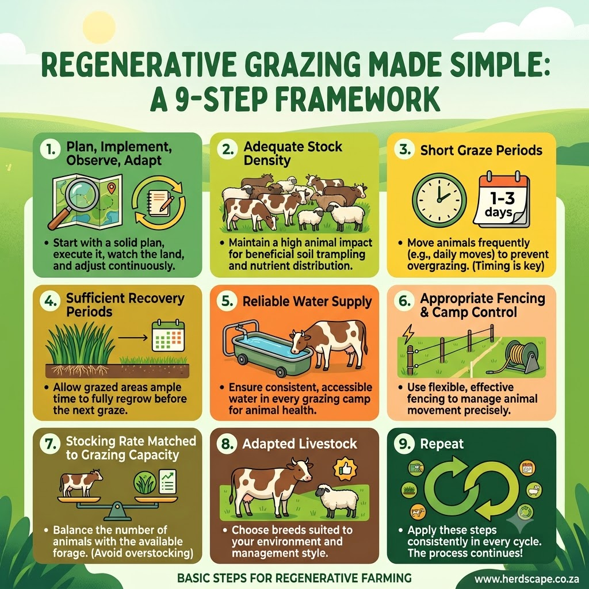
The priorities may be ranked as follows:
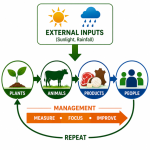
- Plan, implement, observe, adapt
- Adequate stock density (animal impact)
- Short graze periods
- Sufficient recovery periods
- Reliable water supply
- Appropriate fencing and camp control
- Stocking rate matched to grazing capacity
- Adapted livestock
- Repeat
Guidelines for carrying capacities in the different parts of South Africa may be found at:
https://www.gov.za/sites/default/files/gcis_document/201808/41870gon898r.pdf
If you are ready to move from understanding to application,
explore the Herdscape online course in regenerative grazing and livestock management
Read more about Veld and Grazing Management Options:
- From Set Stocking to Regenerative Grazing: Management Changes the Equation
- Farm Records: Five Numbers That Matter
- Profitable Farming Is A Moving Target. Only A Few Will See When It Moves.
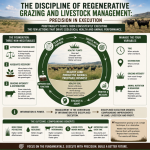
- The Discipline of Regenerative Grazing and Livestock Management: Precision in Execution
- Calculating Carrying Capacity





 English
 Afrikaans