Most farmers do not start keeping records because they enjoy administration, They do it because the law requires it. In reality, that legal compliance is only the starting point, records may begin as a legal obligation but the big bonus for the well-run farm is they quickly become something far more valuable: a tool for protecting cash flow, improving profitability and making better decisions.
Critical Information
Once a good record system is in place it will do far more than keep the tax authorities satisfied; the same records provide the information you need to manage the business with greater clarity and confidence. The most useful information, for you, falls into two broad management categories: cash flow and profitability. They are not the same thing.
Cash flow tells you how the enterprise is surviving. A cash flow budget, or cash flow projection, shows you whether it is likely to survive in the months ahead.
Profitability, on the other hand, tells you whether the enterprise is actually working.
The two should not be confused. A farm enterprise can appear healthy from a cash flow point of view and still be unprofitable. It is entirely possible to produce for a year, sell everything that you produced and still discover that the business has made a loss. The farm is moving cash but the business model is not working.
To Last the Enterprise Must Work
The opposite can also be true. A farm may produce for a year, sell nothing during that period and still show a profit on paper. The business model is sound, it is working, but the farm will not survive without cash flow. It will not last.
A farm business must do both: it must work and it must last. A lack of clarity about the difference is one reason many farm owners feel financially stressed even when the business appears successful on paper.
To give you this kind of insight you will need more than one type of record. Financial statements, invoices and records of production, inputs, stock, sales and assets all play a part. In most cases, these are already being kept for tax purposes. The real opportunity is to organise them so that the same record system serves both compliance and management.
Farmers who want to apply these principles to their own land and livestock can explore
Herdscape’s online regenerative grazing and livestock management course.
Profit That Means Something
It is also worth knowing that “profit” can mean different things depending on who is looking at the numbers. Accounting profit is used for financial statements and tax reporting. Economic profit goes further by considering opportunity costs, such as the value of your time or the return that capital might have earned elsewhere. It is most useful for your internal decision-making, to help you weigh alternatives and consider whether resources are being used to their best effect.
All of this information comes from the same core set of farm records. With a spreadsheet or a basic bookkeeping system, without undue complexity, those records can be analysed and turned into practical management information. It is not difficult and most banks now provide your account records in a form that is compatible with spreadsheets, if you prefer.
That analysis reveals not only the state of your cash flow it also reveals the truth about how your business operates. Which enterprises create value, which is the most profitable and what drives that profitability, or lack of profitability, in your enterprises.
What Drives Profitability in Livestock Enterprises?
We already have a sound understanding of what drives profitability in extensive and semi-extensive livestock systems. That understanding does not come from guesswork, but from decades of benchmarking, herd testing, agricultural research and the observations of producer study groups.
In broad practical terms, profitability in livestock enterprises is shaped by three factors:
- Stocking rate – This refers to how effectively the current grazing capacity of the farm is matched to the current number of animals on the farm.
- Reproduction – Reproduction is one of the clearest drivers of profitability. Strong reproductive performance increases the number of animals available for sale and improves the return generated by each breeding female.
- Cost of production – Even where output is good, profit can be lost if costs are not controlled. The key is not simply to cut costs blindly but to manage them carefully to ensure that inputs contribute meaningfully to production.
How Stocking Rate Affects Livestock Profitability
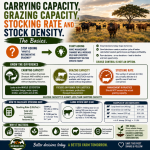
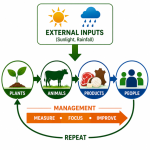
Stocking rate management must take account of actual grazing capacity, which changes with rainfall and season. Stocking rate must match grazing capacity. In good years, a farm will be able to carry more livestock than in dry years. Careful analysis, using a record of actual rainfall, means you can predict feed availability months ahead to make the best use of the current productive capacity of the sunlight, rainfall and soil.
Carrying capacity is not fixed. It changes with the amount of rainfall and it varies with how effectively that rainfall is converted into usable forage. Do not be misled, the amount of rain you get is not the whole story. Time-controlled grazing and stock density management will increase carrying capacity per unit of actual rainfall. Your regenerative grazing and livestock management will increase carrying capacity to the extent that it is possible to double rain-based carrying capacity in three years.
The point is: your profitability increases when your farm carries more animals per hectare, productively, without degrading the veld.
Why Reproduction Matters in Livestock Profitability
Reproduction is the single most important driver of profitability in a livestock breeding enterprise. Effective management will consider the following contributing factors:
- Timing of breeding and length of the breeding season
- Condition of the breeding female at calving/lambing
- Conception rate and inter-calving period
- Selection and monitoring of breeding animals (resulting in better weaning weights, less mortality and better adaptability, for example)
The outcomes of livestock breeding do depend on genetics, but they depend primarily on nutrition. Genetic potential, as valuable as it is, cannot be realised if nutrition is inadequate. Conception rate is a case in point. A cow or ewe may have the genetic potential for high conception rate but if her body condition score is low at critical times of the year she will not conceive.
Conception rate is a very good indicator of profitability: profitability increases as conception rate increases with good nutrition off the veld. Good records are essential to identify strengths and weaknesses in the relationship between these factors.
Managing Cost of Production in a Livestock Enterprise
You cannot starve a profit into your business. Neither can you buy profit simply by spending more on inputs. Profit depends not only on output but on the margin between income and expenditure. The aim is not to minimise spending at all costs but to spend judiciously and with discipline.
Records allow you to compare the cost of an input with the result it produces. Without records, spending decisions are easily driven by habit, peer pressure or assumptions about what “should” work. With records you can ask a more disciplined question: did this cost justify itself?
A low cost of production, incurred judiciously, increases profitability.
Five Numbers: The Drivers of Profit
This will not be news to you but a cash flow budget is an invaluable planning tool for your management. It sets out the cash you expect to receive and to pay out for all enterprises for the year ahead, month by month. As the year progresses your actual receipts and payments are recorded against the budget so that variances can be identified and corrective action taken.
A sound, regular cash flow review is the one practice that will improve your confidence and reduce stress.
The cash balance is one “number” that is always changing. That is normal. It is encouraging if the balance is positive but not an issue if it is temporarily negative, if bridging finance is available. A regular review reduces uncertainty and enables you to anticipate payment timing problems before they become crises.
The five numbers that really matter, however, are the ones that tell you what the drivers of profitability are for your livestock enterprises. They will not vary very much from year to year but they should trend in the right direction, so they are most useful if you calculate them every year to compare and reveal the trends.
Set your goals at the beginning of the year and then to calculate the actuals for these five key performance measures at the end of the year:
Metric 1: Livestock units per hectare, measured as number of days of grazing per hectare per 100 mm of rainfall – should trend upwards.
Metric 2: Conception rate, the percentage of females confirmed pregnant out of the total number of services (breedings or inseminations) within a specific period – should trend upwards.
Metric 3: Inter-calving period, days (cattle, equivalent accelerated breeding metrics for sheep) – should trend downwards to remain below 365 days (cattle).
Metric 4: Weaning rate and weight, the percentage of offspring that survive from birth to weaning and adjusted weight at weaning -should trend upwards.
Metric 5: Cost of Production per unit – should trend downwards.
Gross Margin Per Unit Shows Livestock Profitability
Knowledge of industry and regional norms for each metric assist in goal setting but also enable you to identify the weakest of the drivers in your enterprise. No single metric defines the profitability of the enterprise, on its own. A combination of all five numbers in an analysis leads to the calculation of a gross margin per unit for that livestock enterprise. Stockflow records lead directly to gross margin calculations.
Gross margin per unit provides a practical and essential measure of profitability at the enterprise level, it allows you to identify which enterprises make the strongest contribution to the business. It is equally important to define and measure profitability for the business as a whole.
The Herdscape Foundation Course explains stockflow records and the calculation of Gross Margin.
However, you also require a whole-business measure of profitability by viewing the business from an investor’s perspective and assessing the return generated on the total capital invested in the farm. The ultimate objective is not simply to maximise enterprise gross margins, but to maximise the return on the total resources committed to the business.
If return on assets is below the rate of inflation it means you are losing real wealth over time. Expansion through debt financing would become increasingly risky because interest rates would exceed the returns generated by average farming enterprises. You would be borrowing against land simply to finance operating costs rather than to finance productive growth.
Keeping accurate farm records and knowing “your numbers” creates the foundation for better-than-average business management. Good records provide the information needed to understand what enterprises are working, for you to be sure your business will last.
Regenerative grazing and livestock management practices strengthen the productive capacity of the farm itself. The greatest benefits arise when sound business management and regenerative livestock management work together. They are inseparable. One without the other limits success; together they create a business that is both ecologically and financially resilient.
If you are ready to move from understanding to application,
explore the Herdscape online course in regenerative grazing and livestock management
Read more about Veld and Grazing Management Options:




 English
 Afrikaans