The debate around regenerative grazing may be intellectually stimulating for some, but livestock farmers are asking more fundamental questions.
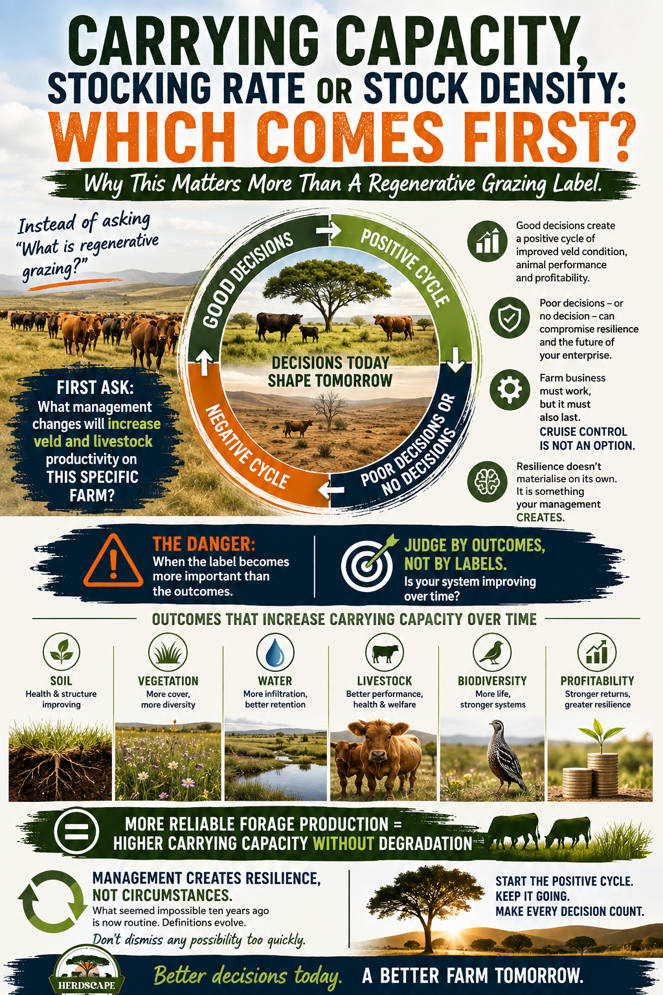
Instead of asking:
“What is regenerative grazing?”
perhaps we should first ask:
“What management changes will increase veld and livestock productivity on this specific farm?”
It is an important question so the answers really matter, even if the solutions may appear almost impossible to achieve in the present. Decisions made in the short term will either initiate a positive cycle of improved veld condition, animal performance and profitability, or contribute to a declining enterprise viability.
The quality of these decisions is critical, their effects are often cumulative and will shape the productive capacity and resilience of the farm for many years to come. Sound, evidence-based management decisions initiate a positive cycle of improvement. Conversely, poorly considered decisions, or lack of any meaningful decision at all, can compromise the resilience and sustainability of the farming system.
The farm business model must work, but it must also last. Cruise control is not an option.
Ultimately, the future productivity of both the veld and the livestock enterprise will be determined less by external circumstances than by the quality of the management decisions made in response to them. Farm enterprise resilience does not materialise on its own, it is something your management creates.
Do not dismiss any possibility too quickly. What seemed impossible ten years ago is now routine, and definitions have continued to evolve.
There is no universally accepted definition of regenerative grazing, nor is there a single “regenerative grazing system.” There is no quick fix. This does not make the concept useless. Rather, it reflects the fact that regenerative grazing encompasses a very broad range of knowledge, principles and management practices and it operates within a complex set of variables.
The danger is when the label becomes more important than the outcomes.
Instead of asking whether a system is “regenerative,” we should judge it by the outcomes it produces. Is it improving soil, vegetation, water, livestock performance, biodiversity and farm profitability over time? When these improvements translate into greater, more reliable forage production in your veld, they collectively increase the land’s carrying capacity, the amount of livestock your veld can support over a specified period without degrading the resource base.
Time to Stop Asking “What is Regenerative Grazing?” – Start Asking “How Do We Manage Carrying Capacity?”
The conventional approach that assumes that carrying capacity is a fixed property of the farm can be very misleading, even if it is not entirely wrong. The problem arises when this long-term planning estimate becomes treated as a permanent physical limit. It obscures the fact that actual veld production varies substantially between seasons and years, and that your management can influence the productive capacity and resilience of the land.
Actual carrying capacity changes with rainfall, temperature and your management. Estimates should be reviewed regularly because planning suffers when an inaccurate limit restricts your options and opportunities.
This does not mean that carrying capacity should be changed arbitrarily whenever it rains or conditions change. Long-term carrying capacity provides a benchmark to guide stocking rate decisions but current forage availability, land condition and your records provide the information needed to adjust actual stocking rate. The objective should never be to keep stocking rate fixed, it should be to keep livestock demand and the productive capacity of the land in balance. In a favourable season, increasing veld production will provide an opportunity to increase livestock numbers or grazing days (stock days per ha). In a poor season, reducing livestock demand will be necessary to protect the resource.
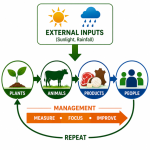
Management influences land condition and veld production; veld production influences carrying capacity and carrying capacity influences the appropriate stocking rate. Carrying capacity therefore becomes not simply a number to be calculated but a resource to be monitored and improved. It does not necessarily, however, always come first. With judicious management:
- in a dry year carrying capacity becomes the priority
- in a good year stocking rate becomes the priority.
The priorities are determined by what the land can actually produce and safely make available to livestock this season, given rainfall, soil moisture, temperature, vegetation condition and grazing records and history.
Farmers who want to apply these principles to their own land and livestock can explore
Herdscape’s online regenerative grazing and livestock management course.
How Will Carrying Capacity Increase? What “Tools” Are Critical?.
This is the practical discussion that most producers are searching for.
Before carrying capacity can increase, several conditions must improve.
- More Plant Growth
Without increased plant growth and veld production, carrying capacity cannot increase.
- Better Recovery Periods
Plants require sufficient recovery after grazing. Fixed grazing schedules often fail because plant growth is never constant.
- Improved Water Infiltration
The priority is to get rainfall into the soil and then to keep it there. If rainfall cannot infiltrate the soil effectively, plant growth will remain limited regardless of grazing strategy.
- Healthy Root Systems
Roots, root exudates, soil biology and root reserves drive long-term productivity.
- Effective Utilisation
Keep the ground covered, plant litter on the soil surface is always good. Beyond that, under-utilised veld production that could have been grazed represents a lost opportunity. Both over-grazing and under-utilisation are to be avoided.
- Management Capacity
Perhaps the most overlooked factor is management. No grazing system succeeds without observation, record-keeping, timely decision-making and adaptation. Infrastructure, livestock genetics and veld condition all matter, but management skill determines whether carrying capacity increases or stagnates.
- Tools
The primary tool for improving carrying capacity is stock density, animal impact, the number of animals per unit area at a particular time. If carrying capacity is an “engine” then stock density is the power in that engine. Concentrate animals into smaller areas for shorter periods, create a more intense grazing event, stimulate and provide for plant recovery, distribute manure more evenly and improve ecosystem function.
The rule is to apply the highest stock density you can (minimum 20 LSU/ha) but for minimum time. It applies in drought conditions and it applies in good growing conditions, but the time of application will differ. Stock density must be applied appropriately, judiciously, in all cases.
If stock density is a tool then carrying capacity and stocking rate are the outcomes of applying the tool. You manage and vary stock density (in hours or days) and stocking rate (in months or years) directly. You vary carrying capacity only indirectly and long-term. The use of the tool comes before the outcome. Used according to the rules, stock density comes first, all the time, before carrying capacity and before stocking rate, but it is not the goal.
When the application of the stock density tool becomes standard operating procedure the requirement for infrastructure changes, particularly the placement and capacity of stock water systems. Stock density cannot be achieved without containment by fences or herding. In large camps with very low stock density, water points can be relatively widely spaced, animals will walk to water if they have to and if they have time to do so. In smaller camps where stock density is high, animals will compete more for food and are not as free to do as they wish, grazing selectively and looking for water.
The graze period and the placement of water and fencing are also tools in the toolbox when stock density increases.
Desired Outcomes
For most livestock producers, the desired outcomes are fairly clear. We want healthier soils, more productive pastures, greater drought resilience, improved profitability, and ultimately the ability to support more livestock on the same area of land. We want to increase carrying capacity so that stocking rates can increase sustainably over time.
More time can usefully be spent understanding which management processes are most likely to produce these desired outcomes. The future of grazing management should focus less on labels and more on measurable outcomes. Carrying capacity is one of the most useful outcome measures because it integrates the effects of soil health, plant productivity, water management and grazing management into a single practical metric that matters to every livestock producer.
Carrying Capacity, Stocking Rate And Stock Density — Get the Balance Right
A practical, intensive in-person course for farmers who want to make better grazing and livestock management decisions. Successful grazing management starts with knowing what your land can produce—and managing your livestock accordingly.
Carrying capacity, stocking rate and stock density should not be discussed separately. Understanding how these three concepts interact is fundamental to managing grazing livestock, protecting the land and improving farm performance.
This practical course will show you how to:
- Understand and calculate carrying capacity, stocking rate and stock density
- Understand the relationship between the three and why getting the balance right matters
- Use practical rules, guidelines and decision-making principles to adjust management as conditions change
- Apply management practices that can protect and improve the productive capacity of the land
- Plan practical, cost-effective stock-water systems and fencing infrastructure
- Use grazing and livestock records to turn farm information into useful management decisions
Good management does not require complicated record keeping. The right records, kept consistently, provide the information needed to understand what is happening on the farm, evaluate decisions and adapt management before problems become expensive.
The aim is not to give you another rigid grazing recipe. It is to give you the knowledge, calculations and practical tools to make better decisions for your own farm.
If you are interested in a course in your area please send a message on the “Get In Touch” form at the bottom of this page or send a WhatsApp (icon at bottom left of the page) and we will reach out.
If you are ready to move from understanding to application,
explore the Herdscape online course in regenerative grazing and livestock management
Read more about Veld and Grazing Management Options:
- From Set Stocking to Regenerative Grazing: Management Changes the Equation
- Farm Records: Five Numbers That Matter
- Profitable Farming Is A Moving Target. Only A Few Will See When It Moves.
- The Discipline of Regenerative Grazing and Livestock Management: Precision in Execution
- Calculating Carrying Capacity





 English
 Afrikaans