It was not a farmer, but a botanist, who first sounded the alarm about veld degradation and the eastward spread of the Karoo desert. This was long before regenerative grazing became a serious conversation.
For generations, livestock producers have inherited firm ideas about what good farming looks like. Some of those ideas have served agriculture well. Others, widely accepted and rarely questioned, may have quietly limited adaptation, innovation and veld productivity.
One of the clearest examples of such firm ideas is “set stocking”. Long treated as practical, efficient and normal, it became embedded in farming practice with little reason to challenge it. Yet beneath that simplicity lies a more difficult question: what if a system valued for convenience has also been contributing to veld degradation and declining veld productivity?
The Botanist Who Challenged Conventional Grazing Wisdom
That question began to sharpen when an unlikely voice entered the debate. It was not a farmer, the agricultural colleges or extension services, but a botanist, who first warned that South Africa’s set-stocking grazing practices were damaging the veld and helping drive the Karoo steadily eastward. His name was John Acocks, and his particular challenge to accepted wisdom was among the first to highlight the problem.
He strongly opposed the grazing systems used from the time of the early-1950s wool boom. This, the most prominent wool boom in South Africa, was driven by high demand for uniforms and blankets during the Korean War.
Set stocking remains a common traditional practice because it is simple, requires little labour and running costs are low. It is still used for specific purposes such as lambing, calving and small-scale, low-intensity operations. It still has a role, but commercially focused producers are increasingly shifting toward rotational grazing.
Acocks’ is responsible for a drawing awareness to the need for that shift.
He published his landmark Veld Types of South Africa in 1953 but his active campaign against continuous grazing and the Department of Agriculture’s recommended, low-intensity rotational, 3-4 camp grazing systems occurred during the 1960s. He famously concluded that the Karoo was not necessarily overstocked, but rather “understocked and overgrazed”. Acocks specifically identified these grazing systems as highly destructive and the primary drivers of the land degradation.
The Health of the Veld Is Written on Its Surface
He advocated for a pioneering Non-Selective Grazing approach. His development of non‑selective grazing is central to the development of regenerative grazing management. It was not simply a technical adjustment; it was a paradigm shift.
As a botanist his ‘outsider’ perspective allowed him to see what many others overlooked: that veld degradation was not inevitable and that the health of the veld is “written first on its skin.” By focusing on the condition of the soil surface he revealed how the veld degradation could be slowed or reversed.
Futurist Joel Barker’s insight (The New Business of Paradigms) that change comes from the edge finds vivid expression in Acocks’ work, where a botanist rather than a farmer stood at the edge of conventional farming practice, questioning the entrenched dogma of selective grazing. He revealed how managing the condition of the soil surface dramatically increases the effectiveness of rainfall for veld production. This is where the multiplier effect begins.
The Multiplier Effect of Healthy Soil Function
The shift that Acocks precipitated is not merely restorative—it is transformative. Ecological improvement is cumulative, it triggers a cascade of ecological benefits that reinforce one another over time. Each season of improved soil cover and biological function lays the foundation for greater resilience and productivity in the next.
Acocks likely did not foresee just how far this shift in thinking would go. The larger probability is that non-selective grazing that conditions the soil surface not only restores carrying capacity, but it will also raise it above what Acocks believed existed in pre-colonial times.
In South Africa, carrying capacity benchmarks were developed by the Department of Agriculture and the Agricultural Research Council in collaboration with universities and ecologists. These benchmarks were intended as protective guidelines to prevent overgrazing and veld degradation. They are based on correlations with Mean Annual Precipitation: the more rainfall an area receives, the higher its assumed grazing capacity.
Farmers who want to apply these principles to their own land and livestock can explore
Herdscape’s online regenerative grazing and livestock management course.
Rethinking Definitions and Grazing Paradigms
This framework was sensible and valuable but it is incomplete. Rainfall is undeniably one of the dominant drivers of primary production but these benchmarks contain an important limitation: they are based on rainfall quantity. Not rainfall effectiveness.
Grazing systems that improve ground cover, water infiltration, recovery time and soil function will improve rainfall-use efficiency and improve veld productivity. Poorly managed continuous or set stocking reduces rainfall effectiveness by increasing selective grazing, bare ground, runoff and repeated regrazing. Set stocking converts rainfall into grazing capacity less effectively than well-managed non-selective, time-controlled, and adaptive grazing systems.
This distinction is profound because it means that productivity is not determined by rainfall alone, but by how effectively the ecosystem captures, stores, cycles and converts rainfall into biomass production.
The reality in South Africa is that we increasingly are finding that grazing management which improves the condition of the soil surface does much, much more than merely restoring degraded veld to its former condition. Enlightened grazing and livestock management together with the nutrient cycling of dung and urine accelerates this process. A doubling or trebling of actual grazing capacity is common. On one farm—after years of enlightened, resolute and precise management—a 10% improvement in annual rainfall (i.e. 10% more than long term average) has resulted in a recorded increase in grazing off-take that is many multiples of the original carrying capacity benchmark.
Regenerative Grazing Requires Better Management, Not Just More Movement
Managing the soil surface itself is not especially complicated. The core principles are well understood:
- Use livestock in ways that stimulate rather than weaken the functioning of the veld
- Maintain ground cover
- Encourage water infiltration
- Allow adequate plant recovery
This occurs because healthy grazing systems create positive feedback loops and carrying capacity is not fixed by climate alone. While climate sets broad limits, management determines where a farm operates within those limits.
This does not mean that rainfall no longer matters nor does it justify reckless overstocking or exaggerated claims. What it does suggest is that many traditional carrying capacity assumptions were developed under conditions where degraded soil surfaces, low biological function and ineffective rainfall were treated as normal. If those underlying conditions improve then the productive baseline itself can shift.
This reframes the role of the livestock producer. The farmer is no longer merely managing animals against a fixed carrying capacity determined by rainfall statistics. He becomes an active manager of ecological processes—of infiltration, recovery, photosynthesis, nutrient cycling and biological function.
The gains emerge gradually through cumulative improvements in soil function and ecosystem health, patience and consistency are essential.
The definition of set stocking was useful in an era when grazing management was viewed primarily through the lens of stocking rate and camp size. The assumption was that if a camp was sufficiently large relative to the number of animals, then the grazing pressure would somehow distribute itself sustainably across the landscape. In practice, however, it does not. Developments in time-controlled, adaptive rotational grazing management increasingly challenge the traditional definition of set stocking.
Where rotational systems are carefully managed to control grazing duration, stock density, recovery periods and animal movement, substantial improvements in rainfall effectiveness, forage production, soil cover, and carrying capacity per unit of rainfall have been observed. These improvements arise because plants are grazed once and then allowed sufficient recovery before being grazed again. The system manages time as carefully as it manages stocking rate.
The Real Opportunity: Converting Rainfall Into Biology
The defining characteristic of set stocking is not whether animals remain in a camp for an entire season, but whether they remain long enough to regraze recovering plants repeatedly and selectively. A strong case can therefore be made to alter the definition so that any grazing method in which livestock remain in the same grazing area for longer than three days—regardless of camp size—will function ecologically as a form of set stocking.
This proposed revision recognises several realities:
- Animals can selectively overgraze plants in large camps just as effectively as in small camps.
- Repeated grazing of fresh regrowth begins long before an entire season has passed.
- Time, recovery, and grazing sequence are more ecologically significant than camp size alone.
- Carrying capacity is strongly influenced by the effectiveness of rainfall and plant recovery, both of which decline under repeated selective grazing.
This is not merely a semantic adjustment. Definitions shape management thinking. If set stocking is only understood as “animals left in one camp for months,” then producers may believe they are practising rotational grazing simply because animals are moved occasionally between large camps.
In this sense, modern regenerative grazing management reframes the conversation entirely. The question is no longer merely:
“How many animals can this land support?”
It becomes:
“How should time, recovery, and animal impact be managed so that the land continuously improves its capacity to convert rainfall into biological production?”
Once that shift occurs, it becomes increasingly difficult to define set stocking purely by season-long occupation of a camp. Ecologically speaking, any system that allows repeated selective grazing of recovering plants begins to function as continuous grazing—regardless of camp size or management terminology.
Set stocking should now be defined as any grazing method where animals remain in a camp for longer than three days, regardless of camp size. This definition reflects the ecological principle that if animals are in the camp beyond three days then selective grazing and inadequate plant recovery begin to dominate, undermining veld health and carrying capacity.
Grazing Management Is Really About Managing Complexity
The future of extensive livestock production depends less on rainfall itself, which farmers cannot control, and more on learning how to optimise the effectiveness of every drop that falls. The real opportunity lies not simply in receiving rain, but in managing soils, plants, livestock and veld recovery in ways that convert rainfall into sustained biological production, ecological resilience and long-term profitability.
The encouraging reality is that producers do not have to discover these principles through decades of costly trial and error on their own. Much of the ecological understanding, management experience and practical insight required to build resilient grazing systems already exists. What is needed is access to the grazing management principles and knowledge in a form that is practical, coherent and directly applicable to real farming conditions.
Knowing the principles and successfully applying them across a real farming business are two quite different things. The real difficulty lies not in understanding grazing, but in managing complexity. A livestock enterprise is a living system shaped by constantly changing variables such as rainfall variability, fluctuating markets and rising input costs.
The Herdscape Course, a structured regenerative grazing and livestock management course, provides more than technical information. It develops the frameworks and disciplines needed to manage an entire enterprise with greater clarity and purpose. It equips the producer to plan ahead rather than merely react to crises.
It encourages objective monitoring and measurement so that decisions are based on evidence rather than assumption or habit. It strengthens the ability to analyse trends, identify emerging risks, and adapt management before problems escalate.
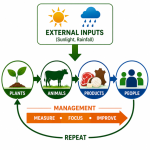
Importantly, such a course exposes the relationship between ecological function and profitability. Too often these are treated as separate concerns, when in reality they are deeply interconnected. Healthy soils improve rainfall effectiveness. Improved rainfall effectiveness supports more reliable forage production. Better forage production improves animal performance and resilience. Greater resilience reduces dependence on expensive interventions. Over time, this strengthens profitability and reduces business vulnerability.
If you are ready to move from understanding to application,
explore the Herdscape online course in regenerative grazing and livestock management
Read more about Veld and Grazing Management Options:




 English
 Afrikaans