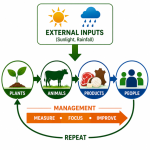
Successful extensive (veld-based) livestock businesses are not built on knowing more—you build yours by consistently executing the few management actions that matter most. The actions that matter most this year are not always the same as last year.
Where livestock businesses underperform it is not because the producer lacks knowledge. They underperform because the few decisions that matter the most are not planned, measured and executed with precision. The profitability of a veld-based livestock system is not created by doing more; it is created by doing the right things at the right time. Doing the right thing is situational, not fixed—it varies with the situation. Rainfall, forage growth, animal requirements and markets are dynamic, it is best if management adapts appropriately to the changes.
Every grazing enterprise operates within a strategic framework that links daily operating decisions directly to grazing ecology, animal performance and profitability. When you record and assess the pertinent information, make your decisions and then act in alignment with the regenerative grazing principles and the true drivers of profit then biological performance and enterprise performance reinforce one another.
The challenge is seldom understanding only “what” should be done. The challenge is planning accurately, executing consistently and measuring whether your intended outcomes are actually being achieved. Without reliable information, management becomes reactive rather than deliberate and focussed. If decisions become based on assumptions and perceptions instead of evidence then execution is likely to become ineffective.
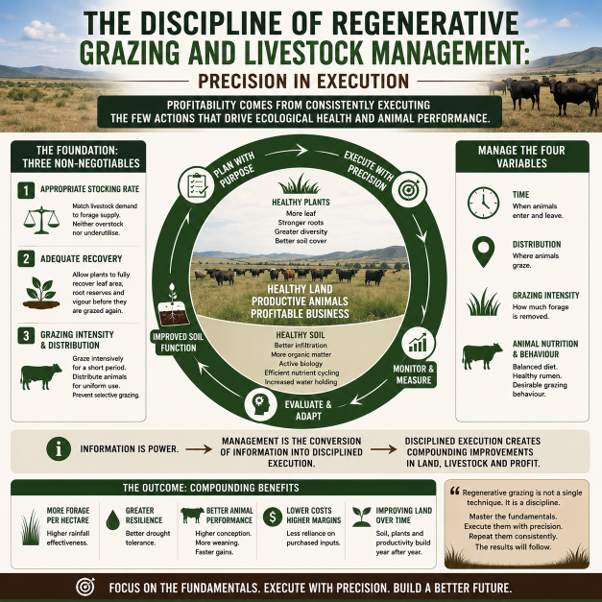
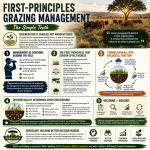
Non-Negotiable Management Actions
Certain management actions cannot be compromised because they determine the productive capacity of the grazing resource itself:
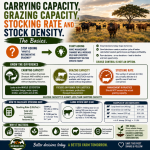
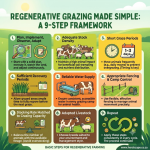
- Balance stocking rate and carrying capacity
Match stocking rate to actual forage production rather than to historical or benchmark carrying capacity. Carrying capacity is not a fixed number, it is the outcome of rainfall effectiveness and management of stock density, graze period and plant recovery.
- Promote dietary diversity but control the mouth
Livestock require more than quantity—they require variety. They have the nutritional wisdom to seek and select it. Maintaining diverse plant communities encourages a wider dietary intake. The more biodiversity the better. Your grazing management should actively promote mixed grazing rather than allowing animals to selectively consume only the most palatable plants. Animals naturally graze selectively, you must control when and how animals graze and for how long. Appropriate stock density and short grazing periods encourage uniform utilisation, reduce selective grazing and stimulate the ecological processes that build healthier soils and more productive veld.
- Leave adequate residual biomass in the growing season
During the growing season residual grass left after grazing is not wasted feed, it is biological capital. Standing biomass protects soil from temperature extremes, improves rainfall infiltration, supports soil organisms and allows plants to resume photosynthesis immediately after grazing. Leaving sufficient residual leaf is one of the highest-return investments a producer can make in future production.
- Allow adequate rest and complete recovery
Recovery is measured not simply by the regrowth of individual plants but by the restoration of the entire plant community. It is as important at the beginning of the growing season as it is at the height of the growing season. Adequate recovery maintains species diversity, replenishes and strengthens root systems, improves resilience during dry periods and increases long-term carrying capacity.
- Plan and monitor. Adapt.
Management actions cannot be put on cruise control. Planning is crucial but the plans themselves are dispensable. Adapt to circumstances as they change. Your management actions must be relevant to what is happening on the ground today.
Farmers who want to apply these principles to their own land and livestock can explore
Herdscape’s online regenerative grazing and livestock management course.
Managing the Four Variables That Matter
Effective grazing management is fundamentally about controlling four variables. Every grazing decision will influence one or more of these variables;
- Time – when animals enter and leave a camp and how long they are kept out of it before returning.
- Distribution – how many animals (LSU) in the camp, how many per unit area in the camp.
- Grazing intensity – how much forage is removed in that graze period.
- Animal nutrition and grazing behaviour – ensuring livestock consume a balanced diet while expressing desirable grazing patterns. Animals with the highest nutritional requirement at that time must get first pick.
The Real Drivers of the Profitability of the Livestock Enterprise
While many factors influence financial performance, three drivers currently determine a large part of the profitability of the extensive livestock enterprise.
- Stocking Rate per Hectare (directly related to turnover)
The number of productive animals carried per hectare (LSU/ha) determines turnover. Overstocking reduces plant recovery and future production. Understocking leaves productive capacity unused. The objective is not to maximise livestock numbers but to optimise the amount of product sold per hectare over many years.
- Reproductive Performance (related to turnover and gross margin per unit)
Conception rate and weaning percentage determine biological efficiency. These depend on nutrition, body condition, animal health and the timing of management interventions. Every empty female represents lost production that cannot be recovered. Monitor the critical “gateways” to reproductive performance.
- Gross Margin per Unit (related to the contribution made to business overheads)
Gross margin is determined by the difference between the value of production (income plus net inventory) and direct costs, not by production alone. Feed, supplements, veterinary costs and purchased inputs should all generate measurable positive returns. The more nutrition supplied by productive veld, the lower the dependence on purchased inputs and the higher the gross margin. Manage for a positive gross margin and a positive change in inventory.
The “Three Secrets” of Profit – Diagnose the Weakest Link
Profit can be expressed as a function of turnover, direct costs and overheads. Put very simply as:
Profit = Turnover − Direct Costs – Overheads
Improving your profitability begins with identifying which of the three contributing factors currently limits profitability the most. Identifying that constraint requires information and a diagnostic framework that compares your numbers to industry benchmarks.
Turnover, or gross revenue, is the total value of farm products and services sold over a given period. If the difference between turnover and direct costs is high, and the margin between the two covers the business overheads, then you will make a profit. (Hence stocking rate and reproductive performance affect the turnover driver).
Direct costs (variable or directly attributable costs) are expenses that fluctuate directly with the number of animals or the scale of production, they are best measured as a component of gross margin. High direct costs are only justified if they lead to significantly greater revenue and a higher gross margin, the value of production less direct costs. If your direct costs increase but your value of production remains flat then your gross margin will shrink. (Hence direct costs affect the gross margin per unit driver).
Overheads are the fixed, administrative and maintenance expenses required to keep your farm operating, regardless of how much livestock or produce you raise.
Ask three questions:
- Are overheads too high?
- Is turnover too low?
- Is gross margin per animal inadequate?
The weakest link (the bottleneck) should always be addressed first because fixing it unlocks the compounding benefits of the other contributing factors. Improving a non-limiting factor rarely produces meaningful gains, as entertaining as it may be at the time.
Additional Principles Often Overlooked
Several additional principles consistent with this framework determine whether the system is resilient under variable seasonal and financial conditions.
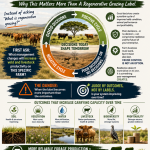
- Match animal demand to forage supply, continuously.
Your stocking decisions must align with actual rain-based forage supply and the actual LSU based animal class and stage of production ratings. The question is not how many animals the farm can carry annually, but how many animals the veld can support today without compromising recovery and forage supply tomorrow.
- Use forage budgeting as a core management discipline.
Forage should be budgeted in the same way as cash. Estimate available feed, actual rain-based growth, required residual biomass reserves and planned grazing days before decisions are made. Turn grazing management from observation-after-the-fact to deliberate forward planning.
- Protect soil cover and improve rainfall effectiveness.
The primary resource being managed is not grass but the water cycle. Adequate ground cover reduces evaporation, slows runoff, improves infiltration and allows more of each rainfall event to be converted into plant growth. This is the practical basis of increasing carrying capacity without increasing rainfall.
- Set trigger points for adjustment before the crisis arrives.
Adaptive management works best when decisions are made early. Declining residual biomass, poor cumulative rainfall, loss of animal condition, reduced forage availability or reproductive risk should trigger planned adjustments to stocking rate, grazing pressure, supplementation or marketing.
- Measure leading indicators, not only final outcomes.
Profit, conception rate and weaning percentage are important results, but they are lagging indicators. Grazing days per camp, residual biomass reserve, recovery period, body condition score, forage availability and quality and cumulative rainfall provide earlier warnings and allow you to adapt while there is still time to act.
- Manage for resilience rather than short-term utilisation.
The objective is not to harvest every possible kilogram of grass in the short term. The objective is to build a livestock business that can remain productive through variable rainfall and market volatility. Resilience is created by preserving recovery, protecting soil function, maintaining animal performance and reducing dependence on purchased inputs.
Avoid the “Red Herrings”
Many producers devote enormous energy to factors that have relatively little influence on long-term profitability. Several common misconceptions deserve particular attention.
- Carrying capacity is not fixed.
Many regard carrying capacity as an inherent property of the land. In reality, the limiting factor is often rainfall effectiveness—the amount of forage produced from each 100 mm of rainfall. Grazing management can substantially increase forage production without increasing rainfall. CARRYING CAPACITY IS NOT FIXED.
- Supplementation complements veld production—it does not replace it.
Well-managed veld supplies most of the nutrients required by grazing livestock. Strategic supplementation should support rumen function and correct the seasonal deficiencies rather than compensate for poor grazing management. If veld forage is inadequate then feeding from the bag is “substitute” feeding. There is no economic benefit to feeding animals just to maintain condition. Veld management is paramount.
- Genetics is rarely the primary constraint.
Genetic improvement undoubtedly contributes to productivity and it must be maintained, but its effects are gradual and incremental. It is already highly advanced. When reproduction, nutrition, grazing management and animal production are limiting, improving genetics delivers only marginal financial benefit. The largest improvements will come from improving management before improving genetics.
- Precision Creates Profit
Exceptional livestock businesses are built through disciplined execution rather than isolated innovations. They identify the management actions that matter, measure them consistently and execute them with precision. Profitability is not the result of doing more, it is the result of doing the right things, every day, with accuracy, consistency and purpose.
If you are ready to move from understanding to application,
explore the Herdscape online course in regenerative grazing and livestock management
Read more about Veld and Grazing Management Options:
Profitable Farming is a Moving Target. Only a Few Will See When it Moves.



 English
 Afrikaans