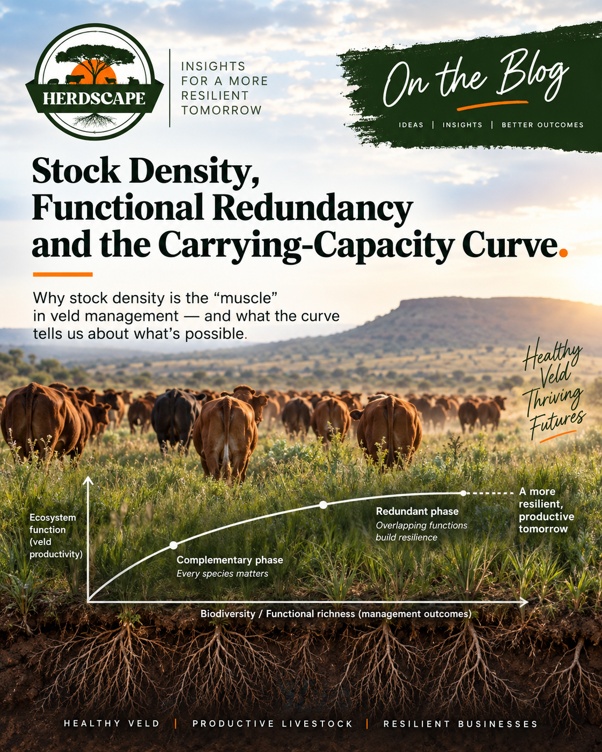
The central theme of the recent Herdscape article on why stock density is the “muscle” in veld management is that stock density is powerful, but it is not a shortcut. Its value depends on timing, duration, veld recovery, rainfall, grazing capacity and the skill of the manager. Used badly, it will damage the veld. Used well, judiciously, it will create ground cover, reduce selective grazing, improve litter distribution, support water infiltration and retention and enable plants to rebuild root reserves and above-ground biomass.
Stock density is one way you can convert animal behaviour into beneficial ecological “work”. When animals are bunched for a short period and then moved on, their grazing, trampling, dunging, urination and herd effect changes how plants, soil organisms, litter, seed and water interact.
Predictions From Biodiversity Theory
Veld productivity is an outcome of ecosystem function, it is not simply a fixed property of rainfall or land type. The older functional redundancy models in biodiversity research asked how ecosystem function might change as biodiversity or species richness in the veld increases.
A common prediction there was that ecosystem function (hence veld productivity) rises rapidly at first, as new species add new traits, roles and forms of ecological work. After a point, however, the curve might begin to level off because additional species appear to perform similar functions to those already present.
That levelling-off idea became known as functional redundancy. It did not mean that the additional species are useless. It meant that, under a given set of conditions, several species may appear to contribute similar functions.
The difficulty is that those conditions are rarely fixed in real agricultural landscapes. Rainfall varies, grazing pressure shifts, recovery periods change, soils differ and drought exposes functions that may not be obvious in a short-term or controlled experiment.
The original biodiversity redundancy theory has been critiqued and refined but it is not outdated or discredited. The “redundancy hypothesis” suggested that ecosystems contain “superfluous” species that perform identical functions, meaning some species could be lost without impacting the ecosystem. Today, the theory has evolved from “some species are redundant and do not matter” to “overlapping roles are vital because they provide the backup systems that keep ecosystems alive during a crisis, a part of ecosystem resilience known as functional insurance.”
Farmers who want to apply these principles to their own land and livestock can explore
Herdscape’s online regenerative grazing and livestock management course.
A Farm-Scale Signal is Now Emerging
What is exciting is that the pattern predicted by biodiversity–ecosystem function research now appears to be materialising on farms that have been deliberately managed for regenerative outcomes. After a decade or more of intentional, deliberate management, the farms have moved beyond the slow establishment phase and into a steeper, almost exponential phase of improvement in carrying capacity per unit of actual rainfall.
This is not simply a claim that stocking rate has been increased. The more important claim is that rainfall-use efficiency has improved. If the same amount of actual rainfall can support more grazing days while soil cover, plant recovery, veld condition and resilience are maintained or improved, then the farm ecosystem is functioning differently. More rainfall is being converted into usable biomass. More biological pathways are contributing to production. The system is capturing, cycling and retaining resources more effectively.
In that sense, farms that have been managed for regeneration (ecological and economic) are now giving practical expression to the early, rapidly rising part of the biodiversity-function curve. The Michaelis-Menten saturation model maps how the curve shifts from a complementary phase, where every species matters, to a redundant phase where functions overlap:
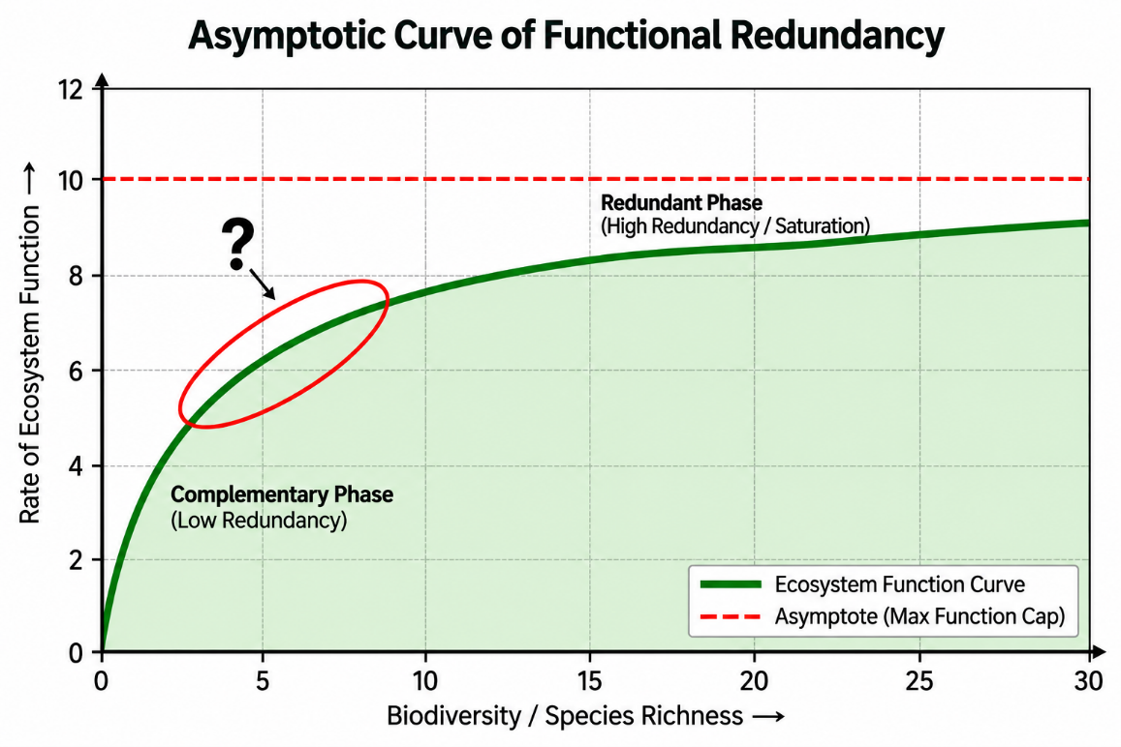
Better grazing management increases the opportunity for more plant species, functional groups, root architectures, soil organisms, litter layers, and recovery dynamics to contribute to ecosystem function. The “rate” of function increases because the system is no longer being held in a simplified, selectively grazed, low-cover state.
Where Is The Levelling-Off Point?
The unanswered question is whether, and when, a redundancy “levelling off” will occur. Functional redundancy models suggest that ecosystem function will eventually approach a plateau as additional diversity adds less new function. But in grazing systems that are regenerating the veld we do not yet know where that plateau lies, whether it is fixed or whether adaptive management can keep changing the ceiling by improving soil structure, water infiltration, root depth, plant recovery and biological cycling.
This is why the current moment is so interesting. The theory predicted that more functional richness should increase ecosystem function, at least up to a point. On farms that have been managed regeneratively for long enough, that prediction appears to be showing up in practical terms as greater carrying capacity per unit of actual rainfall. It is not yet clear where they might be on the curve. The practical results may still be in the accelerating phase, not the plateau phase. The farm records, not the theory alone, will tell us more and will tell us how far the curve can rise.
Why The Rotational Grazing Debate Persists
Experimental veld (rangeland) veld studies have generally found limited evidence that rotational grazing, as a fixed ecological treatment, reliably improves vegetation or soil outcomes. In contrast, farmers report that rotational systems work well when they are used as part of adaptive management: setting goals, observing responses, changing stocking decisions and learning from experience.
Despite the real, farm-scale signals the long-running debate over rotational grazing has persisted because the word “rotational” often hides the real variables. A fixed rotation, applied mechanically, is not the same as adaptive grazing management. High stock density without short graze period and adequate recovery is not regenerative. Rest without monitoring forage supply is not enough. A grazing method cannot be evaluated properly if the management decisions that make it work are treated as “background noise”.
Scientists have often tested grazing systems as treatments. Farmers experience them as decision-making frameworks. That difference matters. A research trial may ask whether rotational grazing produces a consistent average effect across sites. A farmer asks whether changing stock density, timing, recovery and stocking decisions on this farm, in this season, with this rainfall and this veld condition, will improve the trend.
Both questions are valid, but they are not the same question.
What Can We Make Of This?
We can make several things of it.
First, the debate should move away from asking whether rotational grazing works as a generic recipe and toward asking which management variables change ecosystem function.
Second, carrying capacity should not be treated as a fixed property of land determined only by average rainfall. It is also an outcome of how effectively rainfall is turned into forage through ground cover, plant recovery, root activity, soil biology and grazing impact. Besides, average rainfall is seldom, if ever, seen on the farm, only actual rainfall.
Third, functional redundancy may be less a reason to dismiss biodiversity than a warning against shallow interpretation. Species that appear redundant in a simplified system may become functionally significant once management creates the conditions for their contribution to matter. Diversity may be most valuable not only because it adds production in normal years, but because it supplies options, recovery pathways and resilience when rainfall and grazing pressure vary.
The practical conclusion is hopeful. The apparent exponential rise in carrying capacity on long-managed regenerative farms is exciting because it suggests that research predictions are becoming visible in real veld and livestock systems.
We need long-term farm records, rainfall-normalised grazing days, veld monitoring and honest reporting of failures as well as successes. The question is no longer whether management can alter carrying capacity, the better question is how far, how reliably, and under what conditions that increase can continue before the curve levels off.
If you are ready to move from understanding to application,
explore the Herdscape online course in regenerative grazing and livestock management
Read more about Veld and Grazing Management Options:



 English
 Afrikaans