Among all the grazing management practices we can use stock density exerts a disproportionately beneficial influence on regenerative outcomes for the veld. Stock density and herd effect are central to the argument that carrying capacity is not fixed and that it can be increased, but they are tools, not automatic solutions.
Herd effect is the combined physical and behavioural impact of animals moving and grazing as a group. It might be intriguing to suggest that very large numbers of animals in wildlife herds passing through a million hectares provides a model for achieving some of its advantages but that perspective tells only a very small part of the whole story. As soon as you put up a fence everything changes. It is dangerous to suggest otherwise.
The caution is that the animal impact and herd effect that comes with high stock density must be matched to grazing capacity, with short grazing periods and adequate recovery. You need your own farm data and information to do that effectively.
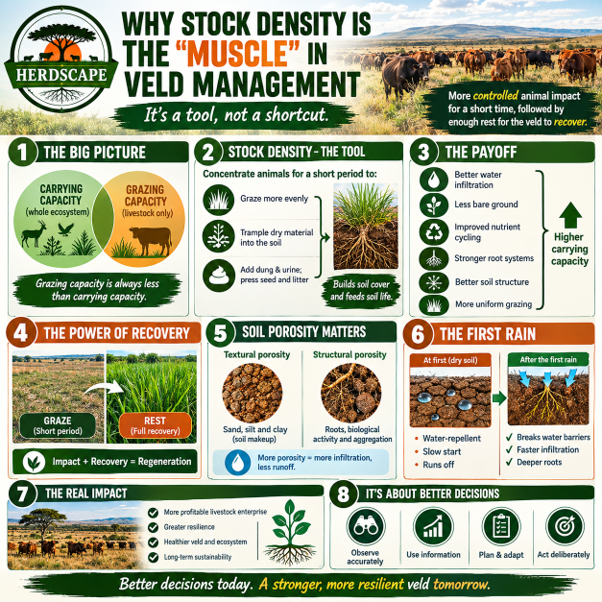
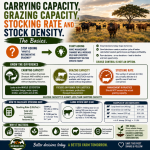
(Grazing capacity is always less than carrying capacity. Simply put it is the veld’s ability to safely sustain just your livestock, not everything that lives there).
If animals remain too long in a camp, or return too soon, the overgrazing effect is harmful. The principle is not “more animals on the land”, it is more controlled animal impact for a short time, followed by enough rest for the veld to recover fully.
The important point is not just the impact, but the combination of impact plus recovery.
Stock Density Is a Tool, Not a Shortcut
Stock density refers to the number animals/animal units concentrated on a given area at one time. High stock density for a short period can create useful animal impact:
- animals graze more evenly
- they trample standing dry material onto the soil surface, breaking up old, oxidised grass
- they add dung and urine and press seed and litter into contact with the ground.
This creates soil cover that feeds soil organisms, reduces bare patches and slows rainfall runoff. Cover protects the soil when the first rain comes. After the first showers have wet the surface of healthy soil the rain that follows soaks in faster and deeper because it the soil is biologically active and structured by roots and soil life. The result is even better soil aggregation, even more biological activity and further improvement in water infiltration and retention. Carrying capacity increases.
For faster, deeper water infiltration, the benefits come mainly through these pathways:
- More litter on the soil surface: Trampled grass becomes mulch, which cushions raindrop impact and reduces erosion, slows water movement and reduces soil capping.
- Less bare ground: Covered soil is cooler, less sealed and less prone to runoff.
- Better nutrient cycling: Dung and urine feed microbes and stimulate plant growth.
- Stronger root systems after recovery: If plants are allowed to regrow fully, they put energy back into root reserves and create more channels for water.
- Improved soil structure over time: Roots, soil bacteria and fungi, dung beetles, termites and other organisms help form stable aggregates and pores in the soil.
- Uniform grazing: Dense herds reduce selective, patch grazing and encourage more uniform use of the veld.
Whether water soaks in or runs off also depends on the porosity of the top layer and how that layer interacts with rainfall intensity. Soil porosity can be broken down into two main categories, textural and structural.
- Textural porosity relates to the soil’s sand, silt, and clay proportions — properties that are inherently tied to the soil’s mineral makeup.
- Structural porosity, on the other hand, is created by the biological activity, plant roots and soil aggregation.
Farmers who want to apply these principles to their own land and livestock can explore
Herdscape’s online regenerative grazing and livestock management course.
The First Rain Prepares the Soil
During the first rain, dry soil initially repels water and slows down absorption. Subsequent rainfall infiltrates much faster and more deeply because the soil is already wet and water-repellent barriers will have broken down.
First Rain: Initial Infiltration and Resistance
- Surface Resistance: Extremely dry soil around plants often becomes hydrophobic (water-repellent) due to dry organic coatings on soil particles.
- Slow Start: Water may initially bead up or run off the surface rather than soaking in evenly.
- Preferential Flow: Water that does break through then travels down channels (macropores) created by grass roots and insect and biological activity, rather than wetting the soil uniformly.
- Gradual Re-wetting: Over the course of the first rain, the soil slowly absorbs moisture, which begins to hydrate the dry particles and lower the surface resistance.
Between Rains: Moisture Redistribution
- Capillary Action: During the hours between storms, water moves deeper into the soil profile driven by gravity and capillary action.
- Breaking Hydrophobicity: The prolonged contact with water dissolves or breaks down the waxy, water-repellent organic compounds coating the soil.
- Balanced Moisture: The upper soil layer transitions from a bone-dry state to a hydrated state, readying the pore spaces to receive more liquid.
Second Rain: Accelerated and Uniform Infiltration
- High Infiltration Rate: Because the antecedent moisture is high and the water-repellent barrier is gone, the second rain starts soaking in immediately.
- Even Absorption: Water moves uniformly through the soil matrix instead of just sliding down root channels or forming puddles.
- Deep Root Penetration: Moisture reaches deeper root zones much faster, efficiently utilizing the secondary rainfall
Under slow, steady rainfall, most soil types will absorb at least some water. During more intense rainfall events infiltration depends on the presence of biological pores/macropores and stable aggregation. Without macropores heavy rainfall may overwhelm the soil surface, leading to runoff and erosion.
Roots, Litter and Soil Life: The Infiltration Team
The reality is that effectiveness of the first wetting event in the wet season depends greatly on the condition of the veld before the rain arrives. Where grazing and livestock management have maintained adequate ground cover, living roots, litter, soil organic matter and biological activity, the soil surface is better protected and structurally more open. Grass crowns, root systems, old root channels, dung beetles, termites, earthworms and all other soil organisms all contribute to the presence of macropores and stable aggregates.
The rain following the first shower is not falling on the same soil condition as the first rain. If the veld has been managed for regenerative outcomes, the initial wetting reduces surface resistance and activates the existing pore network. The second and subsequent rain can then infiltrate more rapidly, more uniformly, and more deeply, so instead of being lost as runoff, a larger proportion of the rainfall is retained in the root zone, where it supports plant recovery, deeper rooting, microbial activity and biomass production.
The Core Relationship
The soil microbiome in a healthy soil is the biological engine behind veld and soil productivity and livestock production. With increased rainfall effectiveness and the improvement and recovery soil microbiome diversity, veld productivity increases. Initially it does so very sharply.
The initial sharp increase in plant growth is dictated via several critical functions. Amongst others:
- Nutrient Cycling: Microbes chemically transform bound or organic elements (like nitrogen, phosphorus, and potassium) into bio-available forms that plant roots can absorb.
- Soil Architecture: Microbial exudates (like glomalin) bind soil particles into stable aggregates. This improves soil porosity, water infiltration and moisture retention—vital for veld resilience during dry periods.
- Pathogen Suppression: A diverse microbiome crowds out, outcompetes and actively fights off soil-borne plant pathogens.
In a healthy ecosystem, with the seasonal increase in diversity, different microbial species begin to perform the same work, like breaking down cellulose or solubilising phosphorus for example.
How the Veld Changes and How Nature Responds
In natural veld on healthy soil the relationship between microbial activity and biomass production (forage for livestock) is governed by a cause-and-effect cycle where one change triggers another change, which then influences the original change. It is a “feedback loop”, a continuous cycle where the results of the microbial activity feed back into the plant-soil system driven by the diversity of the plants growing in the veld. Each new cycle is bigger, stronger or more intense than the last so it is cumulative and the rate at which carrying capacity per unit of rainfall increases is very rapid. The cycle depends upon:
- The Catalyst: High plant diversity (mixes of grasses, legumes, and forbs) provides a varied diet of root exudates (leakage of sugars, amino acids) into the soil. Plants may exude up to 40% of their photosynthetic carbon into the root zone to feed microbes.
- The Microbial Response: This variety fosters and restores a highly diverse community of microbes (microbiome). Early stages of the restoration of the microbiome yield massive improvements in soil structure and water infiltration.
- The Stability Phase: Once the microbiome is established it acts as a stabilising buffer. During severe climate events or grazing shifts, productivity does not continuously surge; rather, the microbiome maintains a high, resilient baseline of veld carrying capacity.
Overgrazing strips away the plant canopy and stops the flow of food from plants to microbes in the root zone. Improving carrying capacity or rehabilitating overgrazed veld is essentially an exercise in restoring the underground soil microbiome so it can build, or rebuild, the aboveground plant community.
The Link Between Grazing, Microbes and Carrying Capacity
To kickstart the process you must address both soil architecture and grazing management simultaneously.
- Break the Soil Cap
Rainfall cannot easily penetrate capped or compacted soil, running off instead and carrying precious topsoil with it. This moisture is the minimum requirement needed to wake up the dormant soil microbes.
- Short Graze Period
High-density, short-duration grazing ensures plants are evenly grazed. The sudden pulse of severe grazing causes plants to slough off part of their root systems underground and this dead root mass serves as an enormous organic food injection for saprophytic soil microbes. A severe graze is not harmful if it is followed by a long rest period of up to 12 months to allow the veld to recover fully.
- Leverage the “Hoof and Dung” Effect
High-density livestock act as biological land renovators when managed properly, herd effects and their dung and urine act as highly concentrated inoculants of active nitrogen, organic carbon and soil microbes. This triggers a rapid spike in soil respiration and nutrient cycling. Use overnight kraaling or high-intensity tramping on severely degraded or bush-encroached “hard pan” areas, followed by long rest
- Enforce Strict Rest and Recovery Periods
The ultimate failure in veld management is not the intensity of the graze, but the lack of time given for plants to recover.
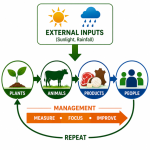
Improved water infiltration and retention is both a result and a driver of veld regeneration. Better-managed veld captures more rain; captured rain grows more grass; more grass feeds more roots and soil organisms; and these, in turn, improve soil structure and future infiltration.
Your livestock, when managed to support recovery rather than continuous pressure, will become part of the process that restores soil function and forage production. The practical significance is that managing grazing and animals for regenerative outcomes does not merely decide how much grass is available to your animals today; it influences how much of the next rainfall event will enter the soil, how deeply it will be stored, and how strongly the veld will be able to recover after drought or dry spells.
Manage the complexity for better production per unit of actual rainfall. Match stocking rate to grazing capacity and apply stock density judiciously, at all times, to unlock the regenerative potential of your veld. That is not something you create or “manufacture”, but you can, intentionally, enable it to thrive.
If you are ready to move from understanding to application,
explore the Herdscape online course in regenerative grazing and livestock management
Read more about Veld and Grazing Management Options:



 English
 Afrikaans