The debate between set stocking and rotational grazing is one of the oldest in extensive livestock farming, and one of the most polarised. Advocates of rotational systems often present them as the obvious path to improved veld health and profitability. Defenders of continuous grazing point to farms that have operated successfully under set stocking for generations. Neither position, on its own, is sufficient.
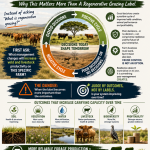
What is often missing from the debate is a more fundamental question: what determines veld productivity in the first place? Rainfall clearly plays a significant role — no grazing system can compensate for a severe and sustained drought. But rainfall alone does not tell the whole story. The effectiveness of that rainfall — how much infiltrates the soil, how much is held and converted into plant growth — is shaped more by management than by chance. A grazing system that ignores this connection is not just incomplete, it is actively misleading.
South African livestock farmers face a complex web of pressures right now, but two challenges stand out as foundational: the need to enhance the effectiveness of rainfall in the soil and the need to remain profitable. Any honest comparison of grazing systems must address both.
From keeping animals out to managing animal behaviour
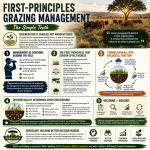
Much of modern grazing management rests on the idea that domestic livestock systems should, in some way, mimic the movement patterns of the vast herds of wild herbivores that once moved across the plains. These herds grazed intensely for short periods and then moved on, driven largely by predator pressure but also attracted by distant rainfall. In doing so they trampled plant material onto the soil surface, disturbed the soil lightly with their hooves, deposited manure and urine, and left behind a landscape that could rest and recover before the next grazing event. The belief is that by recreating these patterns with domestic livestock we can maintain, and perhaps improve, the productivity of the veld.
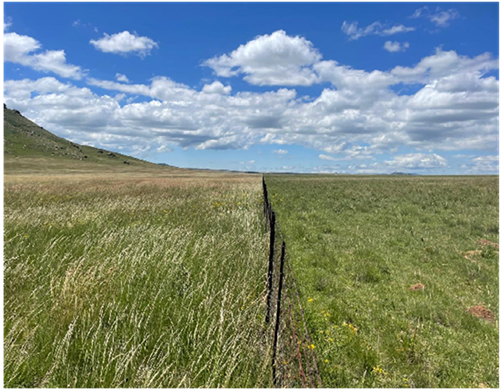
Predators, however, are neither practical nor desirable in most livestock systems, so fences have become the modern substitute. Yet the history of fencing itself is revealing. Fences were originally designed to keep animals ‘out’ — out of crop lands, gardens and settlements — but not ‘in’. Over time that changed and the use of fences evolved into a tool for containing livestock safely within defined areas. More recently fences have become instruments of grazing management, used to move animals systematically away from areas already grazed. In this progression, the role of the fence has shifted from protection to control, and finally to ecological management.
But the fence itself does nothing. It merely creates the possibility for different decisions. What matters is how animals respond within the boundaries created, and how managers use time, density and recovery to influence ecological processes.
Nutritional wisdom and the problem of selective grazing
Livestock possess nutritional wisdom. They naturally seek out plants that are palatable, nutritious and beneficial to them. From the perspective of the animal, the ideal strategy is simple: repeatedly graze the best plants for as long as possible. The animal has no reason to consider the long-term consequences for the plant community or the soil. It does not understand that repeatedly grazing a recovering plant weakens root reserves, reduces ground cover and eventually lowers productivity.
Nutritional wisdom is therefore an advantage but it is also a significant risk. Left unmanaged, it leads to selective overgrazing of desirable species and underutilisation of less palatable ones. This insight is central to understanding why grazing management matters. The purpose of management is not merely to feed animals, but to direct animal behaviour in ways that benefit both livestock and the ecosystem upon which they depend. Grazing systems are therefore not simply methods of moving animals — they are tools for influencing plant recovery, soil function, nutrient cycling, biodiversity and ultimately profitability.
The predator–prey analogy: useful insight or oversimplification?
This is where the romantic image of predators chasing wildlife across the plains begins to lose some of its explanatory power. Predation may have been one influence on herd movement, but it was only one part of a vastly more complex ecological system. Rainfall patterns, seasonal migration, fire, plant succession, soil type and animal density all interacted dynamically. To reduce regenerative grazing management to mimicking predators risks oversimplifying both the past and the present.
Modern livestock managers operate under conditions fundamentally different from those of ancient ecosystems. Today’s farmers must balance ecological stewardship with economic survival, labour constraints, infrastructure costs, market volatility and climatic uncertainty. They also possess the knowledge that wildlife systems never had access to — an understanding of soil microbiology, plant physiology, water infiltration, carbon cycling and animal nutrition.
Farmers who want to apply these principles to their own land and livestock can explore
Herdscape’s online regenerative grazing and livestock management course.
What we now know about soil, rainfall and veld productivity
We now know that the top few millimetres of the soil surface can determine whether rainfall infiltrates or runs off, whether seeds germinate or fail, and whether soil organisms thrive or die. We understand far more about the relationship between photosynthesis and the soil microbiome: how plants feed soil organisms with root exudates, how microorganisms cycle nutrients, and how healthy soils improve water retention and resilience.
The implication is profound. Properly managed grazing does not merely maintain carrying capacity — it dramatically improves the productive potential of the land. This reality invites a deeper and more honest inquiry into grazing systems themselves. If we are serious about improving extensive livestock production it is not enough to rely on ideology, anecdotes or inherited assumptions. We need rigorous, evidence-based evaluation of how different systems actually perform across the range of conditions South African livestock farmers face.
Common mistakes in grazing management
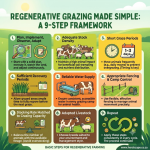
Before comparing systems, it is worth recognising the mistakes that undermine both. The errors that producers commonly make in extensive grazing and livestock management fit mostly into five groups:
- Scale and infrastructure errors: camps too large to allow effective recovery monitoring or controlled grazing duration.
- Timing of grazing and grazing duration mistakes: animals left in a camp too long, or moved back in before plants have adequately recovered.
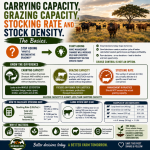
- Stocking rate and stock density errors: mismatching animal numbers to available forage, particularly during erratic rainfall seasons.
- Monitoring and measurement gaps: managing by habit or by calendar rather than by observation of actual veld and animal condition.
- Animal nutrition oversights: underestimating the impact of nutritional stress on animal performance and on selective grazing behaviour.
Each of these mistakes reflects the deeper issue of management by habit rather than by numbers and observation. Camps too large, graze periods too long or rainfall unmeasured are not merely technical errors — they are symptoms of a paradigm that assumes the veld will carry on regardless of how it is managed. Precision, monitoring and adaptive planning are the antidotes, and they apply equally under any grazing system.
Why an honest comparison between grazing systems matters
Set stocking and rotational grazing are often discussed in simplistic or polarised terms. An honest comparison is valuable precisely because it moves the conversation away from dogma and toward understanding. It forces managers to define what they mean by success. Is the goal maximum production per animal, maximum production per hectare, improved drought resilience, lower input costs, healthier soils, or greater long-term profitability? Different systems may serve different objectives.
Set stocking, where animals remain in a camp (paddock) for extended periods, may offer simplicity, lower labour demands and stable individual animal performance under certain conditions. Rotational grazing seeks to manage the timing and intensity of grazing to improve plant recovery and ecosystem function. But the important question is not which system is ideologically superior. The important question is: under what conditions does each system perform best, and by what measures should success be judged?
What a valid comparison should measure
A meaningful comparison must examine far more than immediate animal production. The following seven areas provide a framework for evaluation that connects ecological, economic and management realities:
- Forage Production and Carrying Capacity
Biomass production, grazing utilisation and stocking rates under each system across seasons.
- Animal Health, Nutrition and Production
Weight gain, conception rates, animal condition scores and supplementation requirements.
- Soil Health and Water Infiltration
Soil organic matter, biological activity, rainfall effectiveness and erosion risk.
- Biodiversity and Ecological Function
Plant diversity, recovery dynamics, ground cover percentage and ecosystem resilience over time.
- Drought Resilience and Risk Management
How each system performs under climatic stress, and how quickly the veld recovers afterward.
- Labour, Infrastructure and Management Complexity
Fencing, water systems, labour requirements, management intensity and the skill level the system demands.
- Profitability Versus Production
The distinction between gross output and true economic sustainability — a system that maximises short-term production while degrading soil and veld may eventually become economically fragile.
A grazing method that improves ecology but undermines cash flow is unlikely to survive. Conversely, a system that maximises short-term production while degrading soil and veld condition creates a fragility that compounds over time. Both dimensions matter, and any comparison that ignores either will eventually mislead.
Adaptive management: the real goal
Most importantly, an honest comparison of this kind encourages adaptive thinking rather than blind allegiance to tradition or trends. It recognises that grazing management is not about choosing between old and new ideas, but about learning how animal behaviour, plant recovery, soil biology, rainfall and economics interact within a living system.
The future of grazing management may not lie in merely imitating the ancient relationship between predators and prey. It may lie in developing a more informed and intentional form of stewardship — one that uses modern knowledge to guide animal impact in ways that improve both ecological function and agricultural productivity beyond what natural systems alone may once have achieved.
That is a different kind of goal from simply choosing a system and committing to it. It requires observation, records, willingness to adjust and the courage to question what has long been assumed. It also requires understanding the connections between what happens in the veld, what happens in the soil, and what eventually appears in the farm’s financial results.
If you are ready to move from understanding to application,
explore the Herdscape online course in regenerative grazing and livestock management



 English
 Afrikaans