First-Principles Grazing Management – The Simple Truth
Regeneration Is Enabled, Not Manufactured.
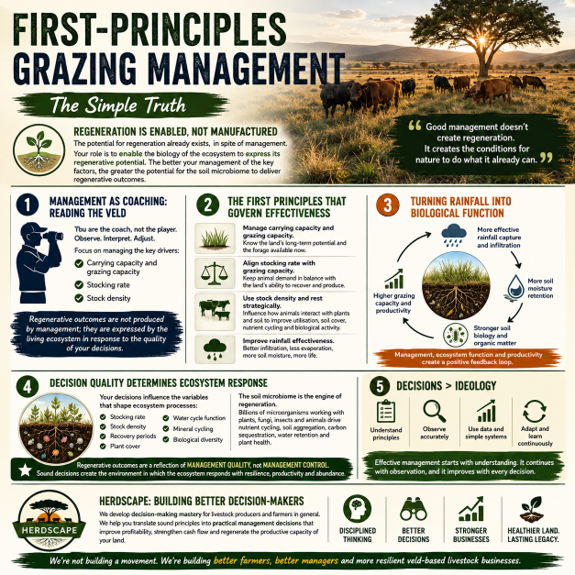
There is an important distinction that is often lost in discussions about regenerative agriculture: regeneration is not managed into existence; it is enabled through management. The potential for regeneration already exists, in spite of management. You do not create regenerative outcomes any more than a conductor creates music. The conductor creates the conditions for musicians to perform at their highest level. Likewise, your management creates the conditions under which the biology of the ecosystem can express its regenerative potential.
Regeneration is therefore not something you do to the land. It is something the land does in response to your effective management. Your role is to steward the factors that influence ecosystem function, allowing nature’s biological processes to express themselves fully. The better the management of those contributing factors, the greater the potential for the soil microbiome to deliver regenerative outcomes.
Management as Coaching: Reading the Veld
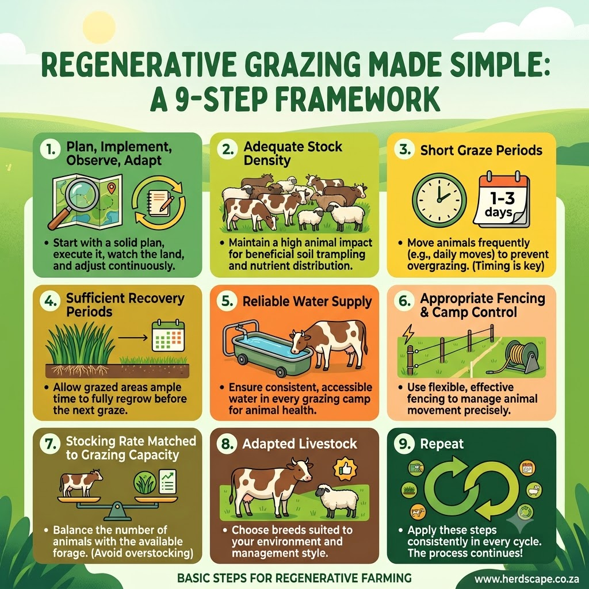
When “Regenerative Grazing” is used as a label it can imply that grazing management, when it results in regenerative outcomes, is a new and separate method of management, fundamentally different from the way veld and animals have been managed in the past. It is not. What is different is the quality, precision and intent of the management decisions being made. The manager is not the player who produces regeneration directly, but the coach who reads the field, understands the core principles that govern veld and animal production and makes timely adjustments that allow the veld to express its full biological potential. This requires close observation, disciplined interpretation and continual adaptation in the management of:
- carrying capacity and grazing capacity
- stocking rate and
- stock density.
Regenerative outcomes are not produced by management; they are expressed by the living ecosystem in response to the quality of the decisions you make. Good management does not force the veld to regenerate. It removes constraints, times interventions appropriately, balances animal demand with biological supply and creates the conditions in which plants, soil organisms, water cycles and grazing animals can interact productively. In this way, the manager’s decisions coax beneficial regenerative outcomes from the veld while it improves the profitability and resilience of the extensive (veld-based) livestock enterprise.
Farmers who want to apply these principles to their own land and livestock can explore
Herdscape’s online regenerative grazing and livestock management course.
The First Principles That Govern Effectiveness
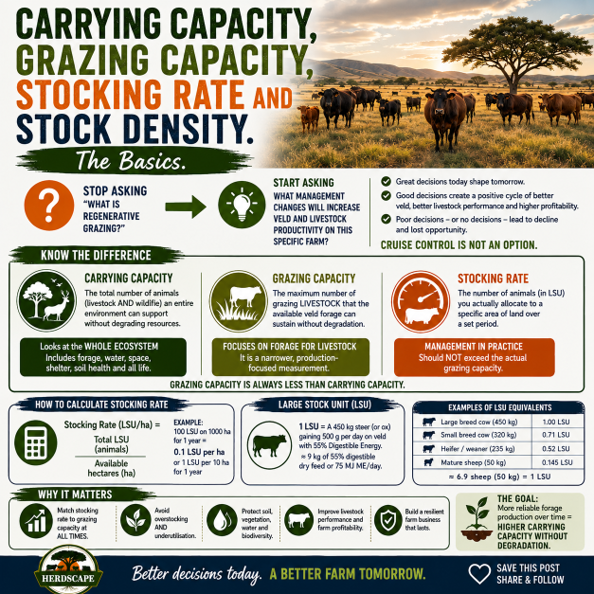
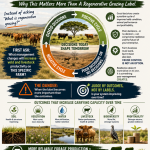
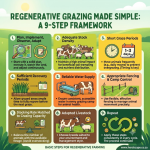
The primary responsibility of management is to understand and work within the biological limits of the land to improve it. This begins with managing carrying capacity and grazing capacity. Carrying capacity determines the long-term ability of the landscape to support livestock and wildlife, while grazing capacity reflects the forage available for livestock, only, at a particular time and under current environmental conditions. Effective management aligns stocking rate with grazing capacity, ensuring that animal demand remains in balance with the land’s ability to recover and produce.
However, successful management goes beyond simply matching stocking rates to available forage. Through the strategic use of stock density and veld rest and recovery you influence how animals interact with plants and soil. Properly managed stock density can improve plant utilisation, litter distribution, soil cover, nutrient cycling and biological activity. In doing so, it can increase the effectiveness with which rainfall is captured, infiltrated and retained within the ecosystem.
Turning Rainfall into Biological Function
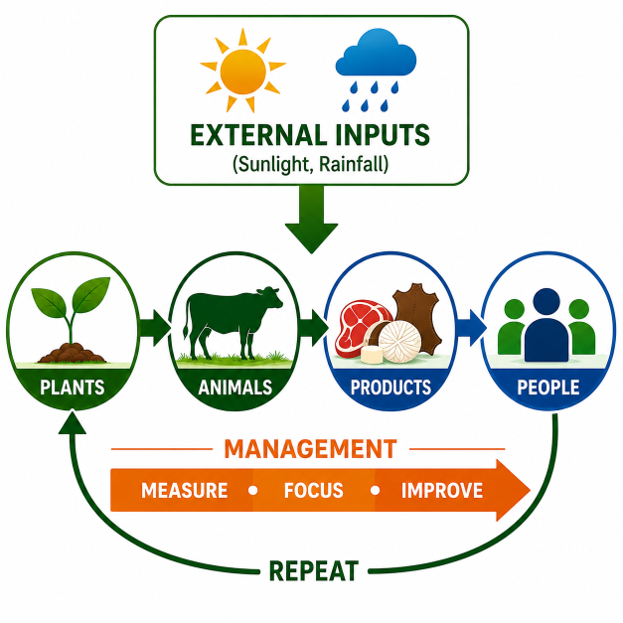
Rainfall alone does not determine productivity. The crucial question is how effectively rainfall is converted into biological function. Well-managed grazing can improve water infiltration, reduce evaporation, increase soil organic matter and enhance the soil’s capacity to store moisture. As rainfall effectiveness improves, grazing capacity increases, creating a positive feedback loop between management, ecosystem function and productivity.
Decision Quality Determines Ecosystem Response
The manager’s influence, therefore, is indirect but profound. Management decisions affect the variables that shape ecosystem processes: stocking rate, stock density, recovery periods, plant cover, water cycle function, mineral cycling, and biological diversity. These decisions determine whether the soil microbiome and the broader ecosystem are constrained or enabled.
The soil microbiome is the true engine of regeneration. Billions of microorganisms, interacting with plant roots, insects, fungi and animals, drive nutrient cycling, soil aggregation, carbon sequestration, water retention and plant health. These biological processes cannot be mechanically imposed by management. They emerge when management consistently creates favourable conditions for biological activity.
In this sense, regenerative outcomes are a reflection of management quality rather than management control. The quality of decisions surrounding carrying capacity, grazing capacity, stocking rate, stock density, recovery and adaptation determines the environment in which the soil microbiome operates. When these decisions are sound, the biological community responds with increased resilience, productivity, biodiversity, and soil health.
Herdscape: Building Better Decision-Makers
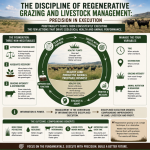
Rather than promoting ideology, Herdscape promotes disciplined thinking and better decision-making in veld-based livestock production. Its purpose is to help producers understand the hierarchy of principles that determines whether management is effective: first the biological limits and potential of the veld, then the relationship between carrying capacity, grazing capacity, stocking rate and stock density, and finally the day-to-day choices that must be adapted to season, rainfall, forage availability, animal performance and business objectives. Herdscape does not ask you to follow a fixed recipe, which generally it not helpful. It equips you to think clearly, observe accurately and act deliberately in conditions that are always changing.
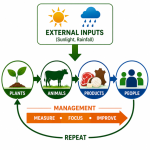
Herdscape develops decision-making mastery for livestock producers and farmers in general. We help producers translate sound principles into practical management decisions that improve profitability, strengthen cash flow and regenerate the productive capacity of their land. This requires more than intuition. It requires powers of observation, reliable data collection and simple systems that convert what is seen in the veld and measured in the business into useful information. That information must then feed back into management, creating a continuous learning loop in which each season improves the quality of the next set of decisions. Herdscape is not building a movement; it is building better farmers, better managers and more resilient veld-based livestock businesses.
If you are ready to move from understanding to application,
explore the Herdscape online course in regenerative grazing and livestock management
Read more about Veld and Grazing Management Options:



 English
 Afrikaans