
Regenerative Grazing in South Africa: A Practical Guide for Livestock Farmers
Introduction
If you farm livestock in South Africa, you may have seen how a piece of veld can deteriorate over your lifetime. You will have seen the bare patches spread. You may have counted the same number of animals on land that should be carrying more, or fewer animals struggling on land that used to carry the same. You may have wondered whether the answer is rainfall, or management, or something else entirely.
In almost every case, the answer is management.
Regenerative grazing is not a new idea. Farmers have been moving cattle across landscapes in a planned way for as long as there have been farmers. What is now well-documented — in South Africa and across southern Africa — is why it works: what the planned movement of animals does to soil biology, to grass root systems, to the water-holding capacity of the land and ultimately to the long-term profitability of the farm.
This guide draws on four decades of working with South African livestock farmers. It will not tell you that regenerative grazing is a silver bullet or that it is easy to implement. What it will do is give you an honest, practical understanding of what the system is, why it matters in our specific conditions and what it takes to make it work on your farm.


Kontak ons vir meer besonderhede; die opsies kan op maat vir jou saamgestel word.
What “Regenerative Grazing” Actually Means
The word regenerative gets used loosely. It appears on supermarket packaging, in government policy documents and in conversations at the co-op counter. Before we go any further, let us be precise about what it means in the context of a working livestock farm.
Regenerative grazing is a management approach that uses planned animal movement to restore and maintain the health of the land, while improving animal performance and farm profitability. It is not simply reducing stock numbers. It is not leaving camps empty indefinitely. It is not a certification or a label.
At its core, the approach rests on three observations:
1. Grass needs to be grazed, rested and allowed to recover in the right sequence
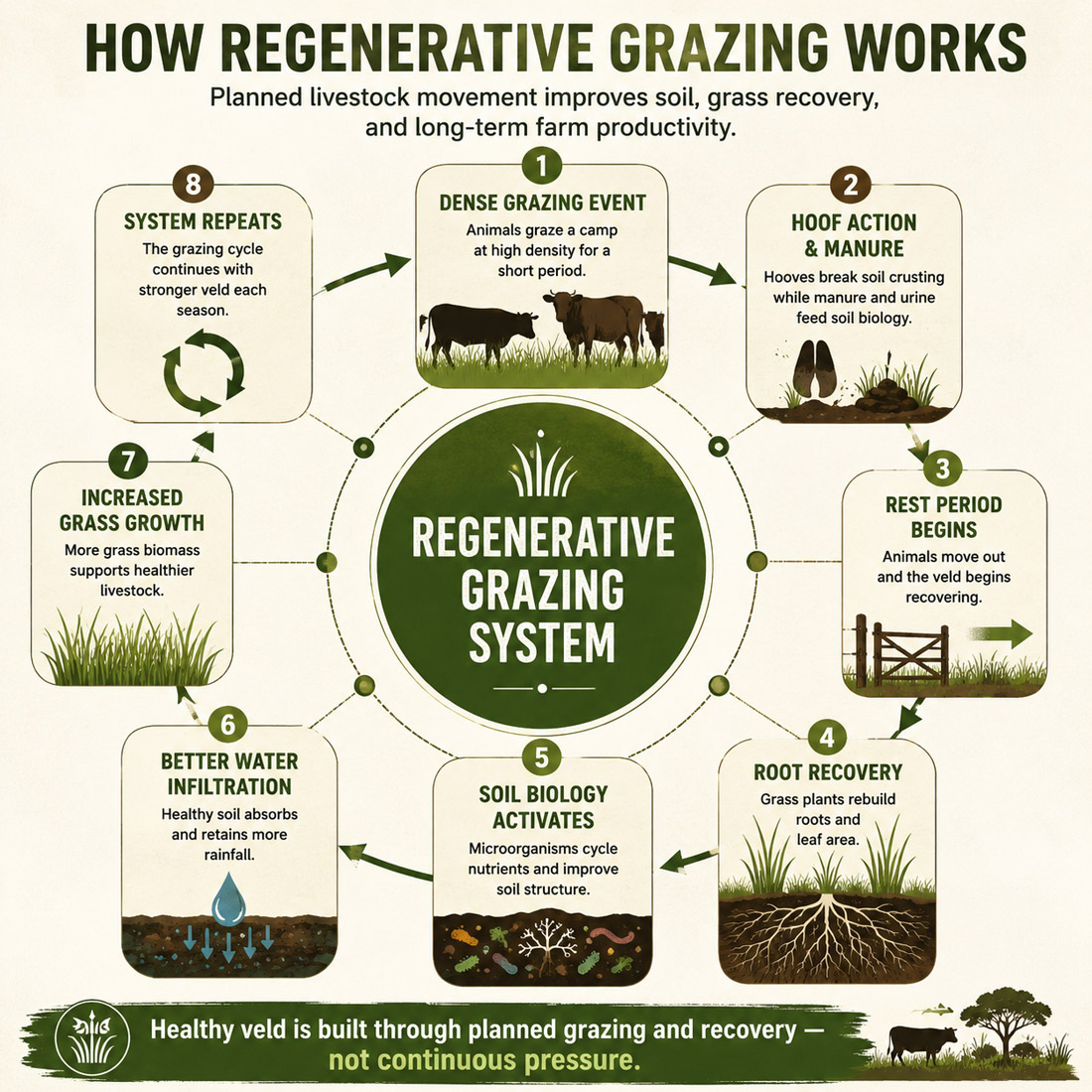
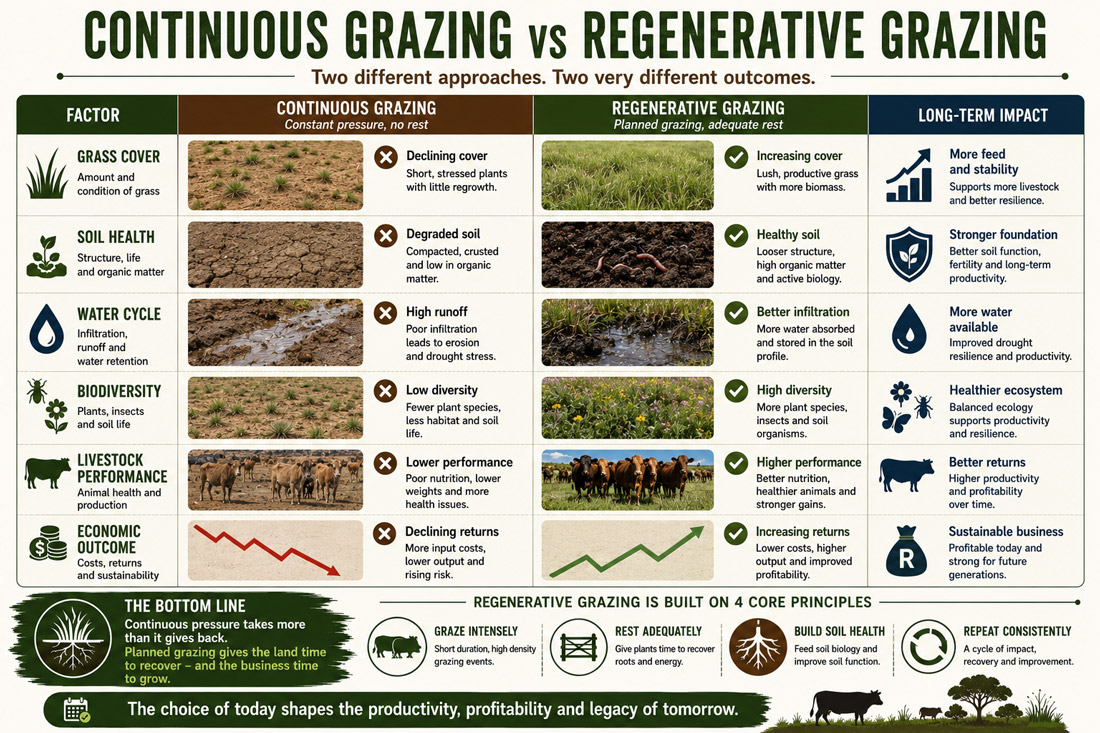
A grass plant that is grazed continuously — never allowed to recover — progressively weakens and dies. The same plant, allowed to recover at the start of the green season, or grazed hard and then left to recover for the right amount of time, grows stronger roots, captures more rainfall, builds more organic matter in the soil, and produces more leaf for the next grazing event. The sequence matters as much as the grazing itself.
2. Soil biology drives plant performance
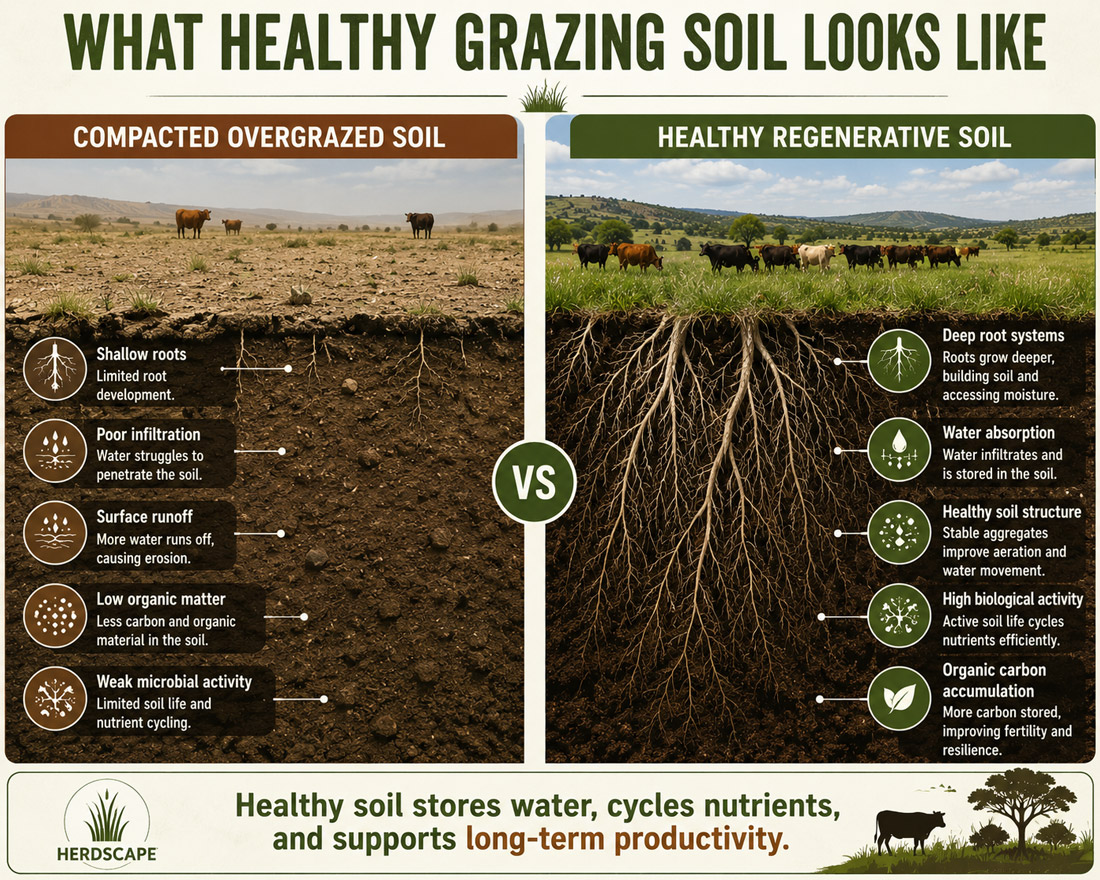
The microorganisms in healthy soil — bacteria, fungi, protozoa, nematodes — are the engine room of the system. They release nutrients, create soil structure and drive the carbon cycle. Livestock, managed correctly, feed this system through trampling, manure and urine deposition, and the physical disturbance of their hooves. Managed incorrectly, they destroy it. The goal is always to feed the system, not to mine it.
3. Profitability follows the land’s health
Farmers who improve their veld condition consistently find that they can carry more animals over time, reduce supplementary feed costs and produce better-performing livestock. The regenerative approach is not an ideological choice — it is an economic one. Your soil is not only your factory floor, it is the largest and most valuable piece of manufacturing “machinery” in your business. It makes everything else work.
Rainfall is merely the raw material. The soil is the machine that converts rainfall into plant growth. Unlike a concrete floor, agricultural soil relies on a complex web of green plants, microbes and organic matter to produce forage for your livestock. Healthy soil appreciates in value, it deserves a deliberate investment in its productivity.
Why South African Conditions Demand a Different Approach
Much of the published material on regenerative grazing comes from the United States, New Zealand, Australia, or the United Kingdom. These are useful resources, but they do not map cleanly onto the South African context. Here is what makes our conditions distinct.
Rainfall seasonality and distribution
Most of South Africa’s livestock farming regions receive highly seasonal rainfall — the majority falling in summer in the eastern half of the country, with winter-dominant rainfall along the south-western and southern coasts. This means the veld has long periods of complete dormancy. Grass that is overgrazed before the dry season enters dormancy stressed and depleted. It takes far longer to recover in the following wet season than grass that was properly rested. Recovery times in South African camps are therefore significantly longer than in higher-rainfall regions and must be planned.
The diversity and fragility of our veld types
South Africa has one of the most botanically diverse grassland and bushveld environments in the world. The Highveld, the bushveld of Limpopo, the mixed Karoo, the sour veld of the eastern escarpment, the sweetveld of the Northern Cape — each behaves differently under grazing pressure. What works in a sweet bushveld camp in the Waterberg does not necessarily work in a sour veld camp in the Eastern Free State. Understanding your specific veld type is not optional. It is the foundation of any grazing plan.
A history of overstocking
South Africa has a long history of overstocking, partly driven by economic pressure and partly by the way farm profitability was measured for generations. Land that has been overstocked for decades does not recover quickly. Initial camp rests may produce disappointing results because the soil biology is compromised, the grass species composition has shifted toward less palatable types, and the root systems are depleted. Farmers who understand this are patient. Farmers who expect immediate results often give up too soon.
Water infrastructure as the limiting factor
In high-density grazing systems, water must be available and well placed in every camp. Getting the water right is not a secondary consideration — it is the first practical, but very detailed conversation to have when planning a transition to a time-controlled, multi-camp grazing system.


Hierdie kursus is ontwerp vir dié wat reeds in die boerdery onderdompel is:
Praktiese boere
Familielede wat by besluitneming betrokke is
Plaasbestuurders en toesighouers
Studente in formele landbouopleiding wat belangstel in die boerdery-wêreld buite die klaskamer
Diensverskaffers—konsultante, adviseurs, verskaffers en opvoeders—wat die werklike realiteite, uitdagings en aspirasies van boerderyfamilies wil verstaan
Baie van die beginsels wat hier ondersoek word, geld ver buite landbou. Hulle is relevant vir enige onderneming wat kompleksiteit, verandering en die spanning tussen tradisie en transformasie navigeer.
The Core Principles: What the System Is Built On
Whatever name you use — rotational grazing, high-density grazing, adaptive multi-paddock grazing, planned grazing — the underlying principles are the same. Understand these and you will understand any variation of the method.
Rest and recovery come before performance
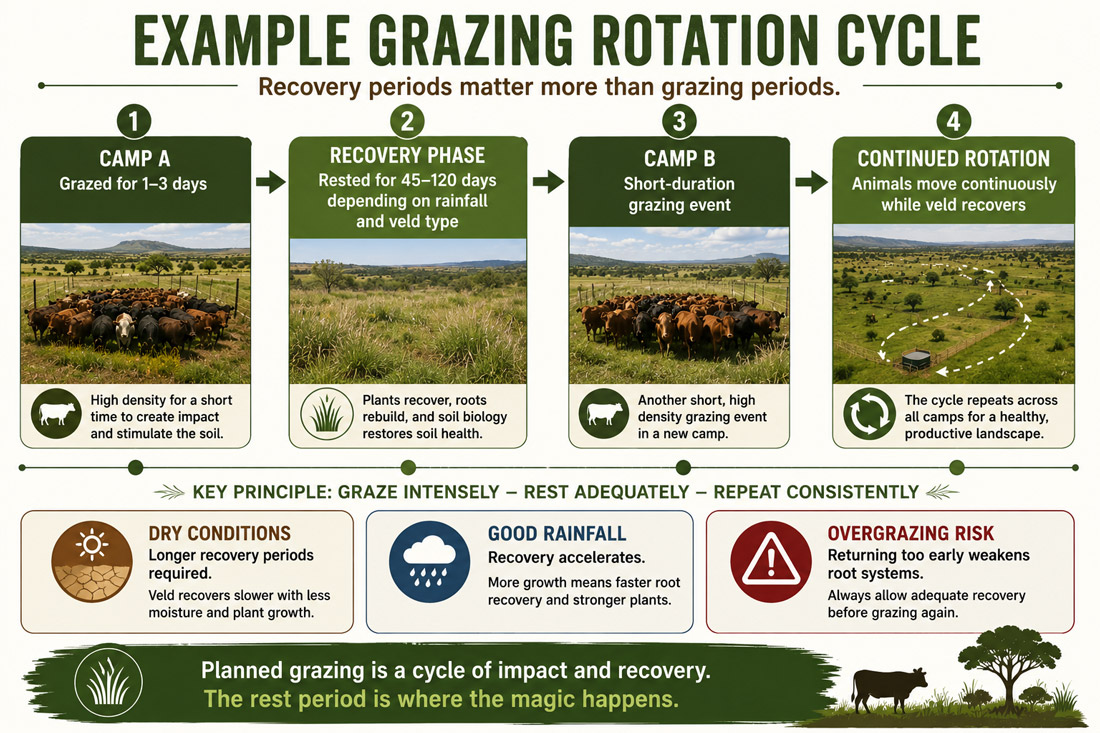
The fundamental insight of all regenerative grazing systems is that the rest period is more important than the grazing event. Grass needs time to re-establish its leaf area, replenish its root reserves and allow soil biology to process the organic matter from the previous grazing. Move animals in too soon and you graze a plant that has not recovered. Do this repeatedly and you weaken the stand progressively.
Most South African farmers who transition to planned grazing discover that they need more camps and less wire than they thought — because more camps, or temporary “grazing plots” and short graze periods mean longer rest periods between grazing events. Longer rest periods are where the recovery happens.
Stock density and stocking rate are not the same thing
This is one of the most important distinctions in grazing management and one of the most frequently confused.
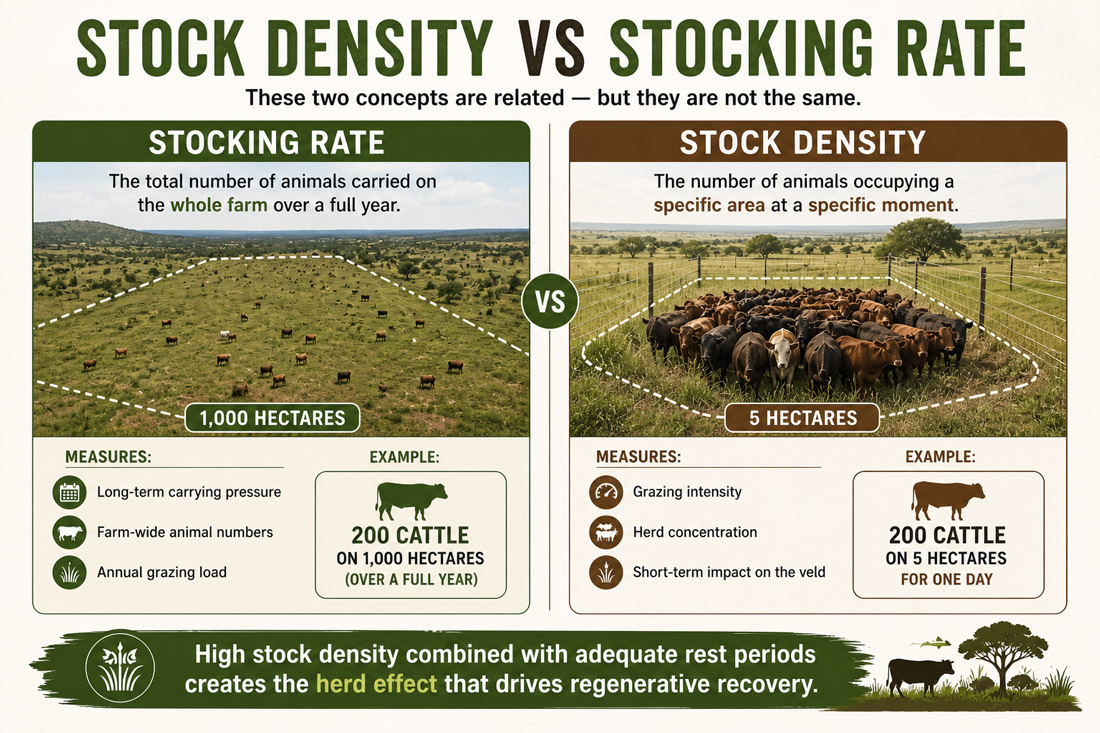
Stocking rate is the number of animals carried on a unit of land over the course of a year. This is what most farmers measure and report.
Stock density is the number of animals per hectare at any given moment in time. In a high-density system, you might have a very high stock density — concentrated animals on a small area — for a short period, then move them out and rest the camp for months.
You can have a conservative stocking rate and a very high stock density. This combination — concentration followed by rest — is the engine of the regenerative approach.
KEY DISTINCTION
Stocking rate: total animals across the whole farm over the whole year.
Stock density: animals per hectare right now, in this camp.
One measures your total commitment. The other measures your management intensity. Both matter. They are not interchangeable.
Timing is the variable you control
You cannot control rainfall, temperature, or cattle prices. You can control when animals enter a camp and when they leave. These two decisions — entry timing and exit timing — are where all your management leverage lies. Enter too early and you set the plant back. Stay too long and you overgraze. Enter and exit at the right moment and you leave a plant that will recover strongly.
The Herd Effect
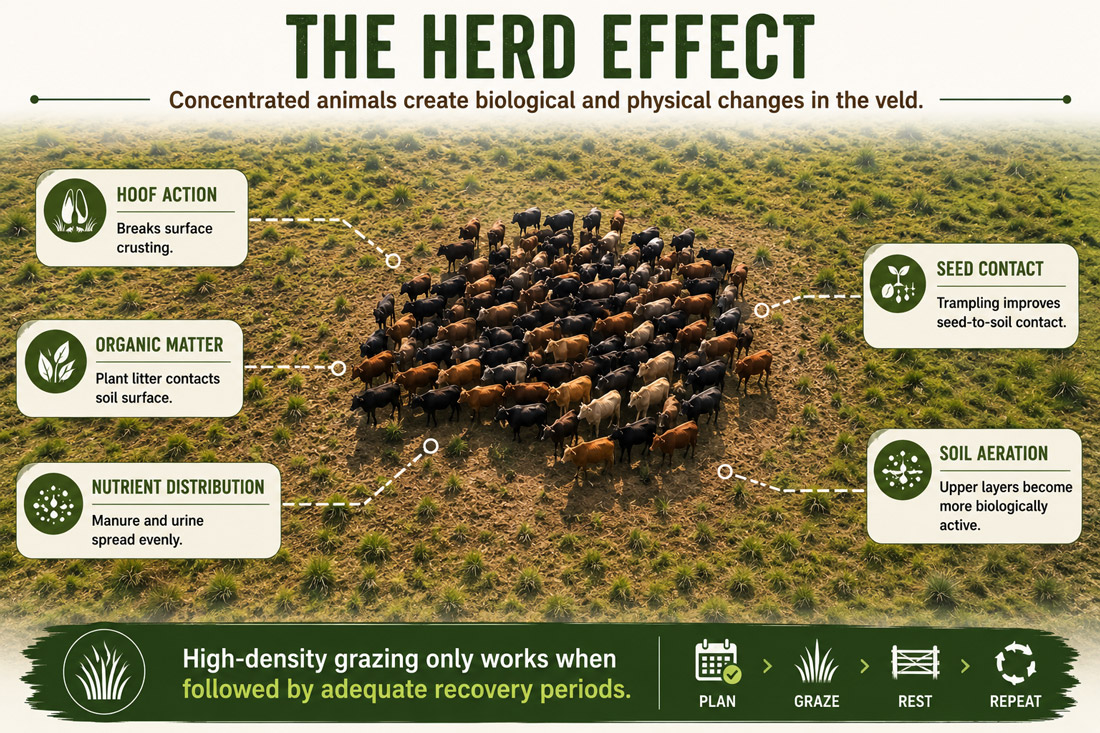
When animals are concentrated at high density, their behaviour changes. There is less selective grazing and they trample more uniformly, which breaks up soil capping and presses seed and organic matter into contact with the soil surface. Manure and urine are deposited more evenly across the camp (note: distance to water is a factor). Hoof action aerates the upper soil layers. This physical disturbance, when followed by adequate rest, accelerates biological activity and soil recovery in ways that a lightly stocked system cannot achieve. This is the herd effect — and it is one of the reasons that high-density, short-duration grazing often outperforms lower-density rotational systems on degraded veld.
The Four Systems: How They Relate to Each Other
Farmers and consultants use different names for different variations of the same underlying approach. Here is how the main systems relate to one another, in plain language.
Rotational grazing
The simplest form: divide the farm into camps, move animals from one to the next on a schedule and rest the camps you are not using. Rotational grazing is a significant improvement over set-stocking, continuous grazing methods and is the starting point for most farmers who have made this transition. Its limitation is that it is typically run on a fixed, calendar based schedule rather than responding to actual grass growth rates, which vary with rainfall and temperature.
Adaptive multi-paddock/camp (AMP) grazing
An evolution of rotational grazing in which the grazing schedule is adjusted continuously based on actual plant recovery rather than a fixed calendar. If summer rains are late and recovery is slow, the rotation slows. If growth is rapid, the rotation speeds up. AMP grazing is more demanding in terms of monitoring and decision-making, but it produces better outcomes because it responds to actual conditions rather than assumed ones. This approach is practised in South Africa today under various names (time-controlled grazing, cell grazing, holistic grazing, management-intensive grazing).
High-density, short-duration grazing
Takes the concentration principle further: a large number of animals on a very small area for a very short period — sometimes less than a day — before moving to the next camp. Rest periods are correspondingly long. This approach is best suited to degraded veld where the herd effect is needed to break compaction and stimulate soil biology. It may require water and fencing infrastructure but careful planning will expose least cost options.
Regenerative Grazing
Regenerative grazing and livestock management uses a formal time controlled and planning process to map out the full year’s grazing in advance, accounting for animal needs, plant recovery and seasonal variation. It is the most comprehensive, principle-based planning and monitoring framework to facilitate decision-making and adaptation when circumstances on the ground change. You cannot dispense with planning but the plan itself can change. This framework is the one that most directly addresses the livestock–soil–water–cashflow-profit system as a whole. The Herdscape course is aligned with these regenerative grazing principles.
The practical question is not which system is “correct” but which approach suits your current infrastructure, your management bandwidth, and the current condition of your veld. Most farmers begin with simple rotation and progressively refine toward adaptive, regenerative management as their knowledge and infrastructure develop. Herdscape caters for both trial scale and advanced large-scale enterprises.
Veld and Soil Health: The Real Goal
A grazing system that produces well-performing animals on degrading land is not a regenerative system. It is an extraction operation. The difference is what happens to the land over time.
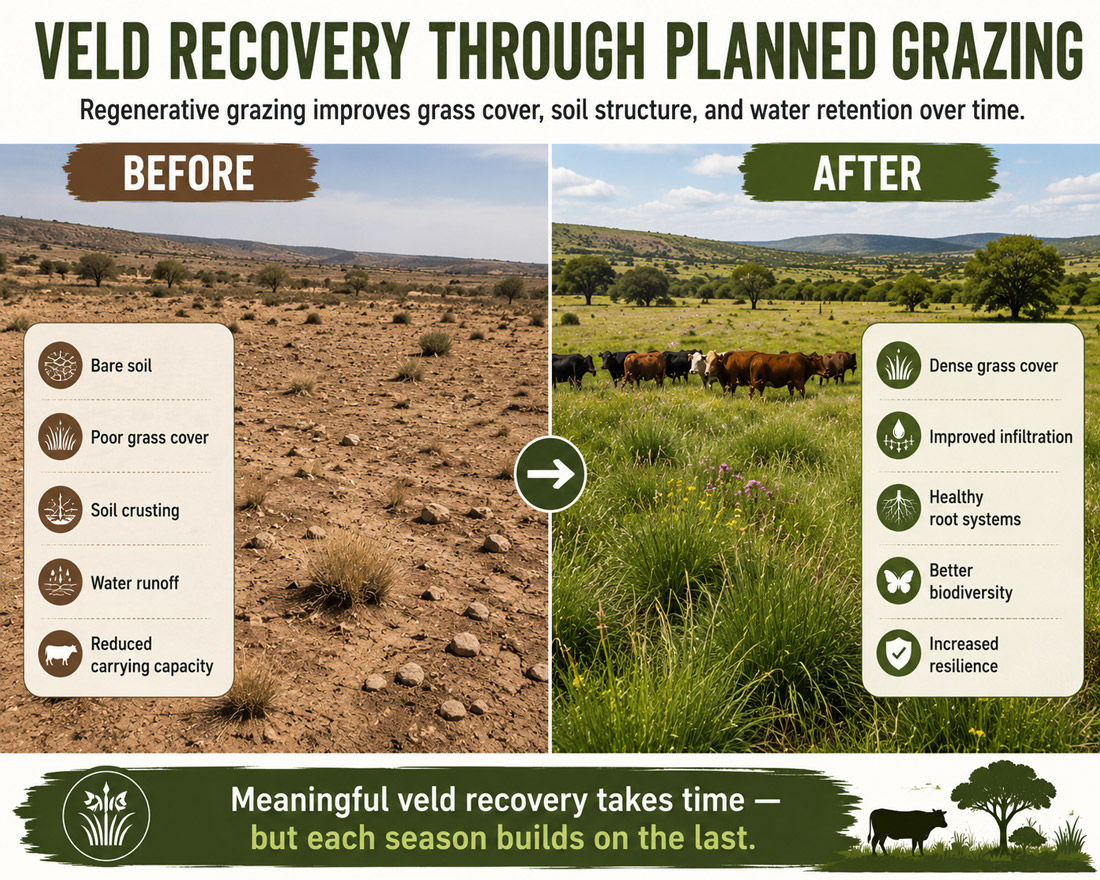
Healthy veld, under planned grazing management, consistently tends toward:
- Increased grass cover and species diversity. As rest periods allow more palatable species to recover and set seed, the botanical composition of the veld shifts back toward higher-quality grasses. On severely degraded land this takes three to five years of disciplined management before the shift becomes clear — but the direction is consistent.
- Improved soil structure and water infiltration. Well-managed soil develops better aggregation — the soil particles clump into structures that hold air and water. This improves rain-use efficiency: a 400mm rainfall year on well-managed soil supports significantly more growth than a 400mm year on compacted, crusted soil. In a country as rainfall-variable as South Africa, this is not a marginal benefit. It is survival-critical.
- Soil carbon accumulation. Grassland soils under good management accumulate carbon — the organic matter that drives biological fertility. Soil carbon is also the basis of emerging carbon markets, which represent a potential income stream for South African livestock farmers who can document management-driven carbon gains. The measurement and verification systems are still developing, but the direction is clear.
- Biodiversity recovery. Properly rested veld recovers not just grass species but the full suite of organisms that a functioning grassland supports: insects, birds, small mammals, soil macro-invertebrates. For farmers this translates into reduced pest pressure, better natural nutrient cycling, and the kind of ecosystem resilience that makes the farm less dependent on expensive external inputs.

We offer a change management environment that addresses both the “why” and the “how” of regenerative transformation. You will deal with the “why” first and the “how” towards the end of the course. You will also be able to attend a practical workshop session and visit a regenerative grazing practitioner if you so wish, after you have completed the course.
Hierdie kursus verg moed—maar dit bring duidelikheid. Dit is vir dié wat gereed is om te beweeg, aan te pas en te lei.
Verduidelik jou visie en belyn dit met jou daaglikse besluite
Hanteer onsekerheid met vertroue en doelgerigtheid
Verminder risiko deur ekologiese, ekonomiese, finansiële en menslike veerkragtigheid
Bou momentum na ’n besigheid wat jou waardes en jou nalatenskap weerspieël
What a Transition Looks Like
Most South African farmers planning a transition to planned grazing ask three questions: How many camps do I need? How much will it cost? And how long before I see results?
How many camps?
The minimum viable number depends on your rainfall region, your current veld condition, and your targeted rest periods. As a rough starting point, most practitioners suggest a minimum of twelve camps for a meaningful short term improvement over any continuous or two-camp rotation. In practice at least twenty camps may be needed to achieve the rest periods that allow full recovery over the medium term. More camps does not mean more costly permanent fencing. There are many options to create smaller “grazing plots” within existing fence infrastructure.
What will it cost?
The dominant initial cost will be in water infrastructure. Fencing costs will vary significantly depending on terrain, material prices, and whether you use permanent or semi-permanent electric fencing. Water infrastructure — pipelines, troughs, additional boreholes — is highly site-specific. Herdscape offers an on-farm cost-to-transition planning framework that helps farmers calculate their specific situation rather than relying on averages that may not reflect the the desired outcome.
When do results show?
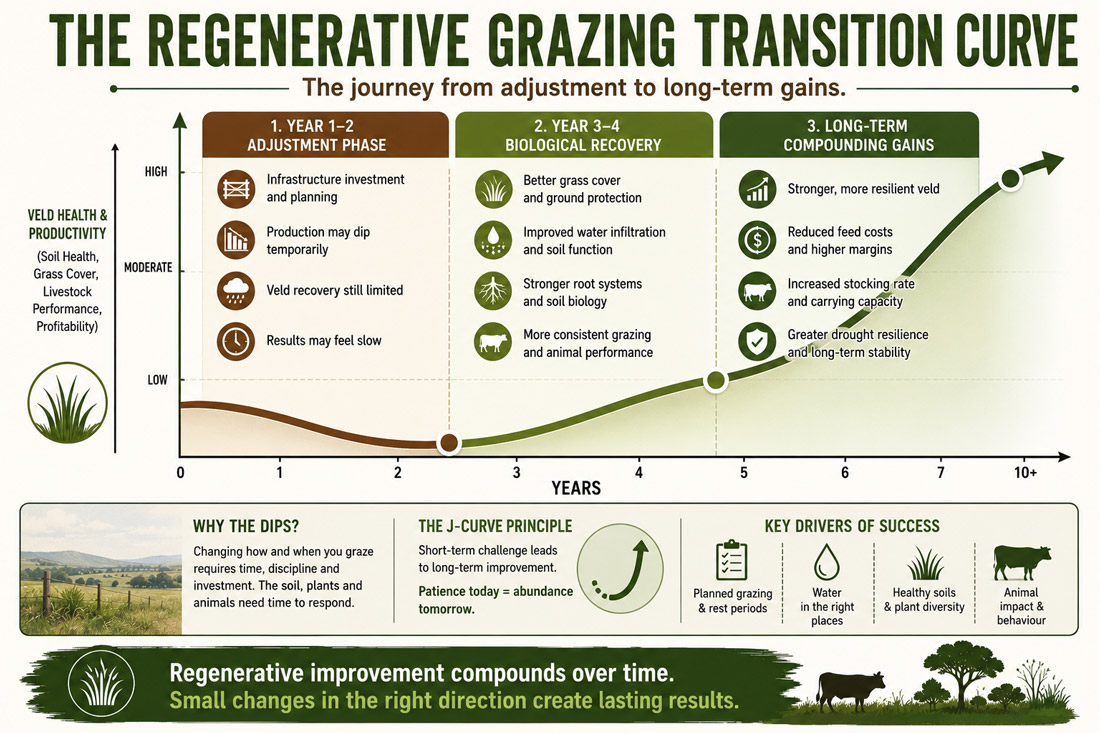
Soil and veld recovery often follow a J-curve. In the first one to two seasons, results can be disappointing and productivity may drop. The land may look worse before it looks better as animals are concentrated and then removed and as grass plants and veld composition begin the process of regeneration. By seasons three and four, the curve typically turns: grass cover improves, recovery times shorten and animal performance data begins to move in the right direction. A doubling of rainfall effectiveness and veld productivity is not uncommon. Farmers who give up in year two consistently report that they wish they had persisted.
What Regenerative Grazing Is Not
It is worth being clear about what the system does not require, because misunderstandings cause farmers to dismiss it before they have tried it, or to adopt a partial version that does not produce results.
It is not destocking
Reducing animal numbers is sometimes a short-term necessity when starting a transition on severely degraded land. But the goal is not to carry fewer animals — the goal is to carry the right number in the right way. Farmers will end up carrying more animals on better-managed veld than they did before the transition, with lower supplementary feed costs.
It is not hands-off farming
Some farmers hear “let the land rest” and interpret it as reducing management intensity. The opposite is true. Planned grazing requires more decisions, more monitoring and more discipline than continuous grazing. You are constantly observing, assessing and adjusting. The reward for that attention is a farm that compounds in productivity over time rather than one that slowly degrades.
It is not a quick fix
The timescale for meaningful veld improvement is measured in years, not weeks. The compounding nature of the improvement — each season setting up a better one — means that patience is genuinely part of the method.
It does not require perfect infrastructure before you start
Waiting until you have the ideal number of camps, perfect water placement and the full fencing budget before beginning is a reason many farmers never start at all. Begin with what you have. Divide one large camp into two with a temporary electric fence. Move animals more frequently. Observe what changes. Infrastructure follows knowledge — not the other way around.
How the Herdscape Course Supports Your Transition
The Herdscape online course was built specifically for South African livestock farmers who want to implement planned grazing in their own conditions, at their own pace.
The course covers:
- The science of grass growth and soil biology in a South African veld context
- How to calculate stocking rates, stock density, and camp rest periods for your specific farm
- Planning your first grazing rotation from scratch
- Fencing and water infrastructure decisions — what you need and in what order
- Supplementary feeding during the transition period
- Monitoring methods that do not require expensive equipment
It is structured as a self-paced online programme, accessible from any device, built for the farmer who is running a full operation and cannot attend a five-day course away from home.
Further Reading
These pages go deeper on the specific topics covered in this guide:
- What is rotational grazing and is it right for my farm?
- How to calculate carrying capacity for your farm
- Stock density vs stocking rate: understanding the difference
- Camp rest periods: how long is long enough?
- The real cost of transitioning to regenerative grazing
- AMP grazing in South Africa: what it means in practice
- High-density grazing: when it works and when it fails
- Veld and soil health: the science behind the system


Ontwerp deur Bunnypants Graphic & Web Design Studio | 2025
 English
 Afrikaans